<?xml version="1.0" encoding="UTF-8"?>
  <feed xmlns="http://www.w3.org/2005/Atom">
    <title>A Working Library</title>
    <subtitle>A working library is a blog about work, reading &amp; technology by Mandy Brown</subtitle>
    <id>https://aworkinglibrary.com/</id>
    <link rel="self" href="https://aworkinglibrary.com/feed/index.xml"/>
    <updated>2026-06-09T16:41:19-04:00</updated>
    <logo>/img/pilcrow.svg</logo>
    <author>
      <name>Mandy Brown</name>
    </author>
    <rights>Copyright 2008–2026 Mandy Brown</rights>
    <entry>
      <title>A Granite Silence</title>
      <id>https://aworkinglibrary.com/reading/granite-silence</id>
      <link href="https://aworkinglibrary.com/reading/granite-silence"/>
      <updated>2026-06-09T16:19:00-04:00</updated>
      <content type="html"><![CDATA[
        <h2><em>A Granite Silence</em> by
        Nina Allan
        (Riverrun, 2025)</h2>
      <p><img src="https://aworkinglibrary.com/img/allan-granite-silence.jpg"/></p>
      <p>In 1934, eight-year-old Helen Priestly sets out from her home in Aberdeen, Scotland, and is never seen alive again. Nearly a century later, Nina Allen walks along Urquhart Road, where Helen lived with her parents, and decides to write about her. What follows is a novel that plays with the notion of a novel; a true crime story that questions which crimes are “true”; a court drama that scrambles ideas of victim and perpetrator; and a speculative fiction narrative that is interested in when and how we speculate—and in what directions we reach. “Even as I try to restrict myself to the facts,” writes Allan, “I come to realize I will never stop being a writer compelled to imagine, and what if the spaces of my mind offer shelter to witches as well as detectives?” What if, indeed.</p>
      <hr/>
      <p><em><a href="https://aworkinglibrary.com/reading/granite-silence">View this post on the web</a>, <a href="https://aworkinglibrary.com/subscribe/">subscribe to the newsletter</a>, or <a href="mailto:mandy@aworkinglibrary.com?subject=Re: A Granite Silence">reply via email</a>.</em></p>
      ]]>
    </content>
    <summary type="html"><![CDATA[In 1934, eight-year-old Helen Priestly sets out from her home in Aberdeen, Scotland, and is never seen alive again.]]></summary>
  </entry>
  <entry>
    <title>Promises and perils</title>
    <id>https://aworkinglibrary.com/writing/promises-and-perils</id>
    <link href="https://aworkinglibrary.com/writing/promises-and-perils"/>
    <updated>2026-05-26T14:24:00-04:00</updated>
    <content type="html"><![CDATA[


        <p>One of the just-so stories we keep hearing about AI is that it’s inevitable, that the technology is here and will continue to be here, and we better get on board or get left behind. These stories have the ring of a threat because they are, explicitly and otherwise, threatening. They are also <em>familiar</em>.</p>
    <blockquote>
      <p>Fear that there may be no alternative to the will of the AI arise because we have been told for decades that there is no alternative to neoliberalism, that there is no alternative to the mediation of all society by profit-driven markets, no alternative to the universal power of private self-interest that continually tries not to better the world, but to maximize it’s own profit and hence power. Stories about the “promises and perils” of AI ring true, not because the AI is poised to hunt all of us down, but because the stories reflect real experiences of technology, capitalism, and ideology; they reflect the capitalist developments of the incomprehensibility of technology, the invisibilization of labor, enclosures, proliferating neoliberal bureaucracies, and the sense that there is no alternative to capitalism and the status quo.</p>
      <p><cite><a href="https://aworkinglibrary.com/reading/why-we-fear-ai">Blix &amp; Glimmer, <em>Why We Fear AI</em>, page 56</a></cite></p>
    </blockquote>
    <p>In other words, the threat isn’t so much that AI is inevitable as that the ongoing—and likely expanding—immiseration of workers is unstoppable. This is the subtext of the strange and conflicted messaging that we get from the hype men: when they say that you better learn AI or be left behind, they are admitting that a great many people <em>will</em> be left behind. And if you—smart and clever and hardworking person that you are—are somehow able to make it to the other side of the line, you’re supposed to find relief or pride at having done so, and not horror at all the people suffering in your wake. You’re supposed to be as uncaring as the capital that uses you.</p>
    <p>But getting through <em>this</em> gauntlet is no guarantee of getting through the <em>next</em> one—and there will be a next one, because the plain aim of the technocrats is to immiserate everyone, eventually. From the capitalist perspective, anyone with skills enough to negotiate a comfortable wage is a cost in need of cutting. Add to that the fact that AI’s whole pitch is that the more you use it, the more data it gathers, the more likely it becomes capable of mimicking you well enough to convince the fools above you that it can do your job. So get-in-or-get-left-behind is something of a trick—everyone is left behind, eventually.</p>
    <p>Which is both terrifying and clarifying. Terrifying in that the capitalists really do have the ability to do us harm—they have been doing so, already. Clarifying in that there really isn’t any reason to stay on the path they’ve laid out for us. It leads nowhere good. Meanwhile, there aren’t very many people up ahead, and there are a whole lot of us back here. Let’s see what we can do. </p>
    <hr/>
    <p><em><a href="https://aworkinglibrary.com/writing/promises-and-perils">View this post on the web</a>, <a href="https://aworkinglibrary.com/subscribe/">subscribe to the newsletter</a>, or <a href="mailto:mandy@aworkinglibrary.com?subject=Re: Promises and perils">reply via email</a>.</em></p>
    ]]>
  </content>
  <summary type="html"><![CDATA[“Fear that there may be no alternative to the will of the AI arise because we have been told for decades that there is no alternative to neoliberalism.”]]></summary>
</entry>
<entry>
  <title>Why We Fear AI</title>
  <id>https://aworkinglibrary.com/reading/why-we-fear-ai</id>
  <link href="https://aworkinglibrary.com/reading/why-we-fear-ai"/>
  <updated>2026-05-26T14:23:00-04:00</updated>
  <content type="html"><![CDATA[
        <h2><em>Why We Fear AI</em> by
    Hagen Blix &amp;
    Ingeborg Glimmer
    (Common Notions, 2025)</h2>
  <p><img src="https://aworkinglibrary.com/img/blix-why-we-fear-ai.jpg"/></p>
  <p>Hagen Blix and Ingeborg Glimmer make a compelling case for why we fear AI: our fears of what AI will do to us are really just our fears of what capitalism is <em>already</em> doing. In this way, AI isn’t so much a novel new technology as an acceleration of long-existing patterns in neoliberal capitalism—automation, deskilling, unaccountability, surveillance, and increasing precarity amidst shrinking welfare systems. But therein also lies a clue as to how to counter it, in that only organized, democratic control of labor can stand up to capital. When we see through the hype, we know what work we have to do.</p>
  <hr/>
  <p><em><a href="https://aworkinglibrary.com/reading/why-we-fear-ai">View this post on the web</a>, <a href="https://aworkinglibrary.com/subscribe/">subscribe to the newsletter</a>, or <a href="mailto:mandy@aworkinglibrary.com?subject=Re: Why We Fear AI">reply via email</a>.</em></p>
  ]]>
</content>
<summary type="html"><![CDATA[Our fears of what AI will do to us are really just our fears of what capitalism is *already* doing.]]></summary>
</entry>
<entry>
  <title>House of Day, House of Night</title>
  <id>https://aworkinglibrary.com/reading/house-of-day-house-of-night</id>
  <link href="https://aworkinglibrary.com/reading/house-of-day-house-of-night"/>
  <updated>2026-05-19T11:10:00-04:00</updated>
  <content type="html"><![CDATA[
        <h2><em>House of Day, House of Night</em> by
    Olga Tokarczuk
    (Riverhead, 1998)</h2>
  <p><img src="https://aworkinglibrary.com/img/tokarczuk-house-of-day.jpg"/></p>
  <p>In a region that was once Germany but is now Poland, a woman and her husband make a life in a house where a stream runs through the foundation. Their neighbors include Marta, an older woman and wig maker, and So-and-so, who tells the story of how young Marek Marek hanged himself. Other stories weave through this place: a man dies on the Czech border and his body is dragged from one side to the other; a young monk writes the story of a saint and longs desperately to be a woman; a husband and wife each fall in love with a mysterious visitor, neither of them knowing of the other’s indiscretion. Occasionally, Germans are seen walking through the fields at night, digging in the ground. There’s a question here about place and displacement, about what happens when the people who built a town come to haunt it, and the people who live in it walk lightly over the ground.</p>
  <hr/>
  <p><em><a href="https://aworkinglibrary.com/reading/house-of-day-house-of-night">View this post on the web</a>, <a href="https://aworkinglibrary.com/subscribe/">subscribe to the newsletter</a>, or <a href="mailto:mandy@aworkinglibrary.com?subject=Re: House of Day, House of Night">reply via email</a>.</em></p>
  ]]>
</content>
<summary type="html"><![CDATA[In a region that was once Germany but is now Poland, a woman and her husband make a life in a house where a stream runs through the foundation.]]></summary>
</entry>
<entry>
  <title>Freedom from unreal loyalties</title>
  <id>https://aworkinglibrary.com/writing/freedom-from-unreal-loyalties</id>
  <link href="https://aworkinglibrary.com/writing/freedom-from-unreal-loyalties"/>
  <updated>2026-05-14T13:35:00-04:00</updated>
  <content type="html"><![CDATA[


        <p>In the work against war, Woolf notes that women—unlike many of their brothers—have four great but perhaps misunderstood teachers:</p>
  <blockquote>
    <p>And those teachers, biography indicates, obliquely, and indirectly, but emphatically and indisputably none the less, were poverty, chastity, derision, and—but what word covers “lack of rights and privileges?” Shall we press that old word “freedom” once more into service? “Freedom from unreal loyalties,” then, was the fourth of their teachers; that freedom from loyalty to old schools, old colleges, old churches, old ceremonies, old countries which all these women enjoyed, and which, to a great extent, we still enjoy by the law and custom of England. We have no time to coin new words, greatly though the language is in need of them. Let “freedom from unreal loyalties” then stand as the fourth great teacher of the daughters of educated men.</p>
    <p><cite><a href="https://aworkinglibrary.com/reading/room-of-ones-own-and-three-guineas">Woolf, <em>Three Guineas</em>, page 267</a></cite></p>
  </blockquote>
  <p>These are strange teachers. We may be forgiven for not seeing them as such when they’ve visited us. Woolf continues:</p>
  <blockquote>
    <p>By poverty is meant enough to live upon: That is, you must earn enough to be independent of any other human being and to buy that modicum of health, leisure, knowledge and so on that is needed for the full development of body and mind. But no more. Not a penny more.</p>
    <p>By chastity is meant that when you have made enough to live on by your profession you must refuse to sell your brain for the sake of money. That is you must cease to practice your profession, or practice it for the sake of research and experiment; or, if you are an artist, for the sake of the art; or give the knowledge acquired professionally to those who need it for nothing.</p>
    <p>By derision—a bad word, but once again, the English language is much in need of new words—is meant that you must refuse all methods of advertising merit, and hold that ridicule, obscurity, and censure are preferable, for psychological reasons, to fame and praise. Directly badges, orders, or degrees are offered, fling them back in the giver’s face.</p>
    <p>By freedom from unreal loyalties is meant that you must rid yourself of pride and nationality in the first place; also, of religious pride, college pride, school pride, family pride, sex pride, and those unreal loyalties that spring from them. Directly the seducers come with their seductions to bribe you into captivity, tear up the parchments; refuse to fill up the forms.</p>
    <p><cite><a href="https://aworkinglibrary.com/reading/room-of-ones-own-and-three-guineas">Woolf, <em>Three Guineas</em>, page 270</a></cite></p>
  </blockquote>
  <p>Woolf is echoing what we already know of wealth, fame, and loyalty—namely, that they encourage possessiveness and defensiveness, that they drive us to the violent defense of prestige and power, and that on <a href="https://aworkinglibrary.com/writing/into-the-gap">that road lies war</a>. We see this possessiveness and defensiveness in the whingeing insecurity of the leaders declaiming DEI; in the boss who insists his workers flatter his every decision, however foolish and arbitrary; in the patriarch who demands obedience from his wife and children; in the man who beats his partner when she tries to leave. (The most dangerous time for a woman in an abusive relationship is always when she is trying to leave.) Woolf, again: “the public and the private worlds are inseparably connected…the tyrannies and servilities of the one are the tyrannies and servilities of the other.”<sup id="fnref:tyrannies"><a href="#fn:tyrannies" class="footnote" rel="footnote" role="doc-noteref">1</a></sup> If we are to prevent war in our public worlds, then we must also root it out in the private.</p>
  <p>And we must root it out among ourselves. For we are no more immune to the appeal of tyranny than anyone else:</p>
  <blockquote>
    <p>And the facts which we have just extracted from biography seem to prove that the professions have a certain undeniable effect upon the professors. They make the people who practice them possessive, jealous of any infringement on their rights, and highly combative if anyone dares dispute them. Are we not right then in thinking that if we enter the same professions we shall acquire the same qualities? And do not such qualities lead to war? </p>
    <p><cite><a href="https://aworkinglibrary.com/reading/room-of-ones-own-and-three-guineas">Woolf, <em>Three Guineas</em>, page 249</a></cite></p>
  </blockquote>
  <p>In naming these teachers, Woolf transforms a proscription into a refusal. The lack of wealth becomes the refusal of it; the lack of fame, of prestige, of authority becomes the rejection of all those ugly and pernicious forces. (The one benefit of living in an era in which we are bombarded with the lives of the super wealthy is we cannot even for one moment forget that they are deranged.) By claiming that lack as a refusal, we release ourselves from longing for that which we can never have; we end a ravenous hunger that could never be sated. For had we great rank and great wealth and all the rest, we would be as eager for war as the warmongers, as miserable and unhappy as the billionaires. Without, we can see war for the horror it is; we can use our time and attention to imagine other worlds, and other roads to get there.</p>
  <p>I think these teachers go by other names—frugality, integrity, humility, and solidarity, to name a few. Like the best teachers, they ask a lot of us. Perhaps too much on some days; we may not always be able to hear them, especially through the din of the war drums and the noise of the platforms and the very real fear of precarity that screams ever so loudly in our ears. But I think perhaps that if we make an effort to listen, we will find that they still have much to teach us, that we still have much to learn. </p>
  <div class="footnotes" role="doc-endnotes">
    <ol>
      <li id="fn:tyrannies">
        <p>Woolf, <em><a href="https://aworkinglibrary.com/reading/room-of-ones-own-and-three-guineas">Three Guineas</a></em>, page 364 <a href="#fnref:tyrannies" class="reversefootnote" role="doc-backlink">&#8617;&#xfe0e;</a></p>
      </li>
    </ol>
  </div>
  <hr/>
  <p><em><a href="https://aworkinglibrary.com/writing/freedom-from-unreal-loyalties">View this post on the web</a>, <a href="https://aworkinglibrary.com/subscribe/">subscribe to the newsletter</a>, or <a href="mailto:mandy@aworkinglibrary.com?subject=Re: Freedom from unreal loyalties">reply via email</a>.</em></p>
  ]]>
</content>
<summary type="html"><![CDATA[Four great teachers.]]></summary>
</entry>
<entry>
  <title>Pedro the Vast</title>
  <id>https://aworkinglibrary.com/reading/pedro-the-vast</id>
  <link href="https://aworkinglibrary.com/reading/pedro-the-vast"/>
  <updated>2026-05-14T11:32:00-04:00</updated>
  <content type="html"><![CDATA[
        <h2><em>Pedro the Vast</em> by
    Simón López Trujillo
    (Algonquin Books, 2021)</h2>
  <p><img src="https://aworkinglibrary.com/img/trujillo-pedro-the-vast.jpg"/></p>
  <p>Pedro is vast, but he is also hidden and mysterious, tucked behind locked doors and a colloquy of priests and doctors. A eucalyptus farm worker, he and several of his fellows fall suddenly ill from a strange fungal disease. None of the others survive, but Pedro slips into a coma and then, miraculously, awakes. His survival brings the attention of a foreign mycologist and an enterprising priest who reckons him a prophet, while his children are left to fend for themselves. Pedro, meanwhile, continues to lurk and rant, his words making little sense, his body succumbing to decay. His story haunts the lives of everyone else trying to survive amid the ruins, waiting—<em>expecting</em>—something to change.</p>
  <hr/>
  <p><em><a href="https://aworkinglibrary.com/reading/pedro-the-vast">View this post on the web</a>, <a href="https://aworkinglibrary.com/subscribe/">subscribe to the newsletter</a>, or <a href="mailto:mandy@aworkinglibrary.com?subject=Re: Pedro the Vast">reply via email</a>.</em></p>
  ]]>
</content>
<summary type="html"><![CDATA[Pedro is vast, but he is also hidden and mysterious, tucked behind locked doors and a colloquy of priests and doctors.]]></summary>
</entry>
<entry>
  <title>Into the gap</title>
  <id>https://aworkinglibrary.com/writing/into-the-gap</id>
  <link href="https://aworkinglibrary.com/writing/into-the-gap"/>
  <updated>2026-05-07T08:13:00-04:00</updated>
  <content type="html"><![CDATA[


        <blockquote class="epi">
    <p>It is right that the murder of many people<br />
      be mourned and lamented.<br />
      It is right that a victor in war<br />
      be received with funeral ceremonies.</p>
    <p><cite><a href="https://aworkinglibrary.com/reading/tao-te-ching">Tzu &amp; Le Guin, <em>Tao Te Ching</em>, page 38</a></cite></p>
  </blockquote>
  <p><span class="drop">H</span><i>ow are we to prevent war?</i> asks Virginia Woolf in the winter of 1937, as photos of the Spanish Civil War pile up on her desk, with their broken bodies and broken buildings, and Hitler and Mussolini gather forces to the east, and her own government’s war budget reaches new extremes. War, she asserts—and you will agree—is a horror, a terror that must be stopped. As well we know, confronted as we are with real-time video of genocide in Palestine,  the massacre of school children in Iran, a fascist leader not abroad but in our own demolished house, asserting his right to make war wherever he likes, whenever he wants, including in our own cities, as armies under other names murder and disappear our neighbors with impunity. But, Woolf asks, what is she to do, what are the daughters of educated men to do in the face of that horror? And what are we, generations later, working women and their allies, how are we to stop it? It’s a good question, and we must spend some time trying to answer it. </p>
  <p>Woolf begins by considering how women might influence the decision to go to war and we may well begin with the same. To influence, we must have some knowledge to impart, some skill in speaking of it, and a listener who would hear us. We have some knowledge—the knowledge that war is a horror, the knowledge that when a missile falls from the sky and rends bodies into pieces that a terrible evil has been done. We can speak of this too, can point to the photos and videos that flit across our screens, children with missing limbs begging for food amid the ruins. These are images and reports of atrocity, undeniably and unequivocally. Yet who would listen, and how? Where can these words be spoken? Here we find we are in some trouble, for the supreme form of speech in our time is not words but money, both in legal doctrine and in fact of order, with our media controlled and manipulated by an obscenely wealthy few who have gobbled up platforms and papers and perverted them to their own aims, aims that seem very much in favor of war, for war has ever been the commander of wealth. When we speak against war we find our words drowned out, lost in the deepfakes and the advertising, the psyops and the slop, the stock market reports, the casual declarations of war crimes, the oil futures, the gilded festivities, the chattering and nattering among a purportedly progressive political class concerned with the appearance of civility but indifferent to its obligations. No knowledge moves through such mediums, only information, a ravening, unending stream of data in which knowing anything is nigh impossible.</p>
  <p>And such is that information that it is frequently as odious as the war it both directly and indirectly leads to: racism, misogyny, eugenics, transphobia. (That last a word that implies fear or aversion when the reality is much more violent, both speech and act that seek to eliminate a people whose courage in seeking their own liberty is among our brightest beacons.) But are these notions not the collaborators and soldiers of capital, and so of war? Are not racism and misogyny the masked recruits who go door to door, kitchen to bedroom to workplace, demanding labor and loyalty and love from an underclass who are threatened with suffering and death if they do not deliver it? Toni Morrison, whose words we may yet remember, said: “And they never, ever thought we were inhuman. You don’t give your children over to the care of people whom you believe to be inhuman….They were only, and simply, and now interested in the acquisition of wealth, and the status quo of the poor.”<sup id="fnref:morrison"><a href="#fn:morrison" class="footnote" rel="footnote" role="doc-noteref">1</a></sup> Racism and eugenics were invented to justify the colonization of Black bodies just as sexism justified the enclosure of women’s.<sup id="fnref:caliban"><a href="#fn:caliban" class="footnote" rel="footnote" role="doc-noteref">2</a></sup> The racists and misogynists of today work the same power: they create a world in which a few wealthy men dictate the material conditions of the lives of millions of others who must serve them, who toil for scraps, whose every step, however small, towards more freedom is violently and immediately resisted, and with overwhelming force—an impulse that you will agree is very much like the impulse to war.</p>
  <p>Look no further than the disproportionate attack on DEI, an effort that saw not to upend capitalism but merely to lightly expand the number of people who might not be entirely crushed by it, but which has been met with an extraordinary campaign to cancel huge swaths of scientific research, retract life-giving knowledge of medical care, hollow out our universities, purge career civil servants and leaders of the armed forces, and to eviscerate the federal workforce<sup id="fnref:unbreaking"><a href="#fn:unbreaking" class="footnote" rel="footnote" role="doc-noteref">3</a></sup>—upending millions of lives and leaving our federal government, already poor from decades of neoliberal retreat, unable to deliver on the basic requirements for the life and liberty of its now abandoned public. That the federal workforce has long been one of the best chances for a comfortable life for Black and brown women excluded from comparable employment in the private sector is of course no coincidence. Meanwhile, the barons of the private sector have likewise backed down from even superficial concern for equality, and now demand such extreme fealty to their enterprises that only someone with no caretaking responsibilities whatsoever—with no care at all, not even for themselves—could possibly meet them.</p>
  <p>“Influence must be combined with wealth in order to be effective as a political weapon,”<sup id="fnref:influence"><a href="#fn:influence" class="footnote" rel="footnote" role="doc-noteref">4</a></sup> Woolf concludes, and we grieve that the only change we can see in the century since is that the gap of wealth has widened, the effectiveness or lack thereof become only more extreme. Woolf was a member of the propertied class, but it was in her lifetime that women earned the right to their own property and were granted access to professional work, such that they might not be entirely in debt to their fathers and husbands. And yet in her time women secretaries were said to be routinely “fagged out” in the afternoons because they couldn’t afford a proper lunch.<sup id="fnref:lunch"><a href="#fn:lunch" class="footnote" rel="footnote" role="doc-noteref">5</a></sup> Today, our food pantries work overtime to feed the working poor, people who work full time and more but don’t make enough to buy bread. Those who do make enough to live on do so in awareness of their intense precarity, the knowledge that they are one illness or storm away from ruin. And even the wealthiest worker has little compared to the investor class pushing for war, those who see war not as an abomination but as yet another opportunity to increase their bloated purse. What is our wealth compared to the billions spent on fighter jets, the <a href="https://en.wikipedia.org/wiki/Tomahawk_missile">$2.5 million</a> spent on a single Tomahawk as it tears through a school full of little girls? What is our wealth compared to the mind-boggling quantities spent on the drones and satellites that make death as easy as clicking a button from the safety of a desk on the other side of the world? The same flick of a thumb can reduce a hospital to rubble or post a racist meme, often one right after the other. What is our wealth compared to the record-breaking <a href="https://www.politico.com/news/2026/01/07/trump-calls-record-defense-budget-00715298">$1.5 <em>trillion</em></a> requested for the military, a military that is already the <a href="https://en.wikipedia.org/wiki/List_of_countries_with_highest_military_expenditures">richest on the planet</a>? <a href="https://www.forbes.com/sites/siladityaray/2026/03/03/trump-says-wars-can-be-fought-forever-with-the-uss-virtually-unlimited-weapons-stockpiles/">Trump</a>: “We have a virtually unlimited supply of these weapons. Wars can be fought ‘forever.’”</p>
  <p>So if money is influence, our relative influence has waned with the rise of the billionaire class. Woolf, recognizing the same, turns her attention instead to education. For if perhaps enough money cannot be mustered to prevent war, then learning—with its values of intellect and reason and enlightenment—may work in our favor, inasmuch as learning grows those faculties of reason, and reason is quite the antidote to the unreason of war. But again we find a problem. In Woolf’s time, while women have ostensibly been permitted into the colleges, they remain excluded from universities, and the women’s colleges are beggarly compared to those gleaming towers. Nor have women been permitted to adorn their names with the same letters and credentials that the men claim, a factor that keeps them from competing for the jobs that require them. It seems that the colleges are less places of learning than they are places of acquiring prestige, a prestige that is fiercely defended and protected, for prestige is a strangely fragile creature who can live only in scarcity and when exposed to too many of its own kind withers and dies like a tree choked by vines.</p>
  <p>And today? Well, women have torn down the gates to the universities, that much is clear. Women make up a <a href="https://educationdata.org/college-enrollment-statistics#college-enrollment-by-sex">majority of all college students</a> in the US, and would be an even greater portion were it not for policies that directly work to <a href="https://www.nytimes.com/2023/09/08/magazine/men-college-enrollment.html">balance the gender of student bodies</a>. But that tearing down has been met by what can nearly be termed a war itself: a livid and indignant assault on places of learning from the men who want war, aiming at what has become the heart of the university, its beating and bloodied endowment. And the universities have, nearly to the letter, <a href="https://www.politico.com/news/2025/03/20/universities-cave-conservatives-trump-00241765">capitulated and retreated</a> in the face of that assault, trading away centuries of purported intellectual freedom in order to protect the money needed to continue to operate, as if operating without that freedom was worth any money at all. Woolf writes:</p>
  <blockquote>
    <p>Is that not enough? Need we collect more facts from history and biography to prove our statement that all attempt to influence the young against war through education they receive at universities must be abandoned? For do they not prove that education, the finest education in the world, does not teach people to hate force, but to use it? Do they not prove that education, far from teaching the educated generosity and magnanimity, makes them on the contrary so anxious to keep their possessions, that “grandeur and power” of which the poet speaks, in their own hands, that they will use not force but much subtler methods than force when they are asked to share them? And are not force and possessiveness very closely connected with war?</p>
    <p><cite><a href="https://aworkinglibrary.com/reading/room-of-ones-own-and-three-guineas">Woolf, <em>Three Guineas</em>, page 193</a></cite></p>
  </blockquote>
  <p>We see that same force and possessiveness in our own time: billions extorted from the universities, while the universities call in <a href="https://time.com/6973166/columbia-university-city-college-pro-palestinian-protests-arrests/">cops in riot gear</a>—gear so named because when worn it inspires one to riot—to descend on students protesting genocide in Palestine. A great irony this would be, if irony were not the first casualty of war. For these brave students were met with war while exercising their right to protest the same, a right which past wars have been fought to defend but in which we seem to have retroactively declared defeat.</p>
  <p>Places of learning are always the first target of the fascist, because they are places that might counter the propaganda and <a href="https://aworkinglibrary.com/writing/pseudo-culture">pseudo-culture</a> that leave us either pacified and accepting of their scraps or else fighting each other instead of fighting those who would start a war. Learning and <em>thinking</em>—a skill the billionaires are trying to supplant with <a href="https://aworkinglibrary.com/writing/toolmen">machines that purport to think for us</a>—are a challenge to the illogic and madness of war. To see an image of the broken bodies and broken buildings, to hear the testimony of those who lived, to have the skill and fortitude to ask how this could have happened, who benefits from such a horror, and how they might be stopped—for they <em>must</em> be stopped—is to exercise a lively mind and spirit, one capable of making the imaginative leap between the way things are and the way things ought to be. That interrogative and thinking mind is a threat to the fascist, who needs you to see things only as he does, who needs you unthinking and unquestioning, because only an unthinking and unquestioning mind could possibly accept the horrors of war. Only a mind so subdued by slop and propaganda and advertising, a mind unpracticed in observation and inquiry and imagination—only such a mind could be complacent as its pockets are picked to fund that most terrible of horrors.</p>
  <p>And so at last we turn to the workplace, as Woolf does, not in the hope that we might make enough money to counter the warmongers—for we have done the math, and no matter how hard we try, there is no chance of that—but because work is where we may, if we’re lucky, earn enough to keep a roof over our head and food in our belly, both of which are necessary to be able to think and act in the world. And we must be able to think, to remember that war is a horror, to resist being anesthetized by the memes and the vapid statements to violence. But here we find a curious contradiction: on the one hand, we are <a href="https://www.thestreet.com/technology/anthropic-ceo-makes-shocking-admission-about-ai">threatened with a lack of work</a>, with our jobs taken over by machines who will never know that war is a horror, because they cannot know anything at all. On the other, high-pitched edicts that we must work so hard that there can be no time to think of anything else, no time to consider how these pictures of broken bodies and broken buildings came to be. (<a href="https://nymag.com/intelligencer/article/elon-musk-twitter-takeover.html">Musk</a>: workers “need to be ‘extremely hardcore,’ logging ‘long hours at high intensity.’”) How can both of these claims be true? How can the investor class simultaneously threaten us with no work, and, at the same time, threaten us with too much? It seems they fear equality more than hypocrisy.</p>
  <p>Perhaps we should also fear the disposition that the professions—which women fought so hard to enter, and now must fight so hard in which to stay—train us for. Here again is Woolf:</p>
  <blockquote>
    <p>And those opinions cause us to doubt and criticize and question the value of professional life—not its cash value; that is great; but its spiritual, its moral, its intellectual value. They make us of the opinion that if people are highly successful in their professions they lose their senses. Sight goes. They have no time to look at the pictures. Sound goes. They have no time to listen to music. Speech goes. They have no time for conversation. They lose their sense of proportion—the relations between one thing and another. Humanity goes. Money becomes so important they must work by night as well as by day. Health goes. And so competitive do they become that they will not share their work with others though they have more than they can do themselves. What then remains of a human being who has lost sight, and sound, and sense of proportion? Only a cripple in a cave.<sup id="fnref:plato"><a href="#fn:plato" class="footnote" rel="footnote" role="doc-noteref">6</a></sup></p>
    <p><cite><a href="https://aworkinglibrary.com/reading/room-of-ones-own-and-three-guineas">Woolf, <em>Three Guineas</em>, page 258</a></cite></p>
  </blockquote>
  <p>It’s interesting to think with Woolf about our current march towards war, as the differences between her time and ours are revealing as much for what hasn’t changed. She wrote at a time when women were still largely excluded from professional work, from universities, from the armed forces. We read her today as women with one or more degrees, with careers, many of us carrying medals won in war zones and the scars to prove them, many of us with pips on our collar, credentials as long as those held by the men who guarded the libraries from the presence of women in Woolf’s time. But in both eras our presence in these places seems to have inspired an extraordinary, and extraordinarily violent, response. The assault against diversity programs is so out of proportion to those programs’ actual impact that we must admit something more elemental is going on: women’s presence in previously precluded spaces (and it is important to note that it is white women who have been the greatest benefactors of diversity initiatives, and Black and brown women who now suffer the greatest costs of their retreat) has inspired a level of violence among a small group of rich, insecure men that they will lay waste to the whole world before they will consider sharing their table with women as equals. Their own self-worth is so mean and spare that it withers when it comes into contact with those who do not bow and bend in their presence. The armed thugs marching through our streets, the speeches about force, force in our own cities, force elsewhere in the world, soldiers rechristened as “warfighters,” all of this is an assertion of manhood, a manhood reduced to nothing more than domination in all things, a masculinity that can see itself only in the violent oppression of others, whether that is other countries, other cultures, other races, other genders, or the more-than-human world. As <a href="https://youtu.be/N1DVvGlzGEs?t=819">Jamelle Bouie notes</a>, “the vision of the world here is the vision of a rapist.”</p>
  <p>We are forced to conclude that to be in possession of a great deal of money, to be in a position of great authority, whether over an institution of learning or of government or of business, is to be in favor of war. The prestige and power that accompany both rank and great wealth—wealth which in our own day has grown so large as to be incomprehensible—also engender an instinct to possession and to the violent and disproportionate defense of that wealth. While we, who have neither great rank nor great wealth, know war to be an abomination, a horror through and through. Yet we can never hope to compete with the warmongers in either arms or cash, in prestige or status. So what are we to do?</p>
  <p>We must refuse to compete at all.</p>
  <hr id="two" />
  <p><span class="caps">We, with our empty hands</span>, know it is right to mourn and lament the murder of many people. And so we mourn, and we lament, and we demand that our would-be leaders stop this incessant and evil warmaking.</p>
  <p>Are those demands enough? It would seem not. It would seem that despite <a href="https://www.pewresearch.org/politics/2026/03/25/americans-broadly-disapprove-of-u-s-military-action-in-iran/">great opposition to war</a>, despite great risk to our economy, to our own safety as we shred our oldest and strongest alliances, that our demands for an end to war land on ears not deaf but blocked, stoppered with ego and greed and lust for domination in all its forms. And perhaps this should be no surprise. For why would a class of people so threatened by the mere presence of women in their schools and governments and workplaces ever open their ears to those women’s demands? Our speech must be a <a href="https://aworkinglibrary.com/writing/gather-your-gossips">very great threat</a> if they are so unwilling to hear it.</p>
  <p>So to speak against war is necessary—necessary for us to speak so with one another, so that we do not forget that war is a horror—yet insufficient. It is not enough to speak against war, for the warmongers, with their infinite money and infinite weapons, cannot hear us against the drums they so loudly bang for war. We must look elsewhere for the path that leads away from here.</p>
  <p>When Woolf was writing, women were precluded from the armed forces, and so could not refuse war by refusing to fight. We today are not subject to the same prohibition. We find ourselves among the ranks of soldiers both on our own soil and on many others. We have not earned the same respect, for many of our brothers seem to believe we have been put there solely for their <a href="https://www.stripes.com/theaters/us/2024-08-15/military-sexual-assault-numbers-14871731.html">use and abuse</a>, and others—the same people who drive us to war, who claim no reason for war save war itself—<a href="https://newrepublic.com/post/203028/pete-hegseth-forcing-women-out-active-duty-military">work to exclude us once again</a>. Yet women make up <a href="https://dwp.dmdc.osd.mil/dwp/app/dod-data-reports/workforce-reports">roughly a sixth of the armed forces</a>, and perhaps as much of the forces in our streets.<sup id="fnref:ice"><a href="#fn:ice" class="footnote" rel="footnote" role="doc-noteref">7</a></sup> Here is perhaps our greatest opportunity to halt the march to war. For we have it within our power to refuse to fight. We who know that war is a horror must refuse to raise a gun or fly a jet or steer a drone heavy with death into homes and hospitals and schools. We must refuse to go door to door in our own cities dragging people without warrant or reason into filthy, inhumane, and hastily built camps—for as sure as killing is a part of war, so too is gathering people up and locking them away. We must drop guns and kevlar and gas masks and walk away from the field of war, whether that field is distant from our homes or just down the street. We may look here to the courage of those like <a href="https://www.nytimes.com/2025/11/03/opinion/israel-dissidents.html">Ella Keidar Greenberg</a>, an Israeli who, at 16 years of age, signed a pledge refusing to enlist in the military and was then, at 19, jailed for that refusal. “Refusal is the imperative,” she speaks, and we who have not plugged up our ears to reason and wisdom can yet hear her, and agree. For to make the horror of war with your own hands is to become a horror yourself.<sup id="fnref:co"><a href="#fn:co" class="footnote" rel="footnote" role="doc-noteref">8</a></sup></p>
  <p>This is easy to say for the great many of us who do not fight in war, who have not raised guns or donned armor or placed hands on keyboards and rained death on schools and hospitals from afar. But the imperative to refusal remains: we must refuse to lend our hands or minds to war, in whatever way we can. And so we must also refuse to work for war, to use our labor to make the technology of war, whether of weapons or of surveillance or of detention, whether that technology is used in our own streets or somewhere afar—for any technology used afar will come home soon enough, as we see with the militaries in our streets, outfit with cast offs from so many wars abroad.<sup id="fnref:cesaire"><a href="#fn:cesaire" class="footnote" rel="footnote" role="doc-noteref">9</a></sup> We must not lend our hand to the making of guns or missiles or drones, of targeting systems or intelligence databases, of satellites that scour the planet for schools and hospitals, of algorithms that prescribe processes for murder, processes that promise to scrub their operators clean of the blood that follows but which will haunt them, nonetheless.</p>
  <p>Is this enough? It is not. For war is such an enormous undertaking—witness the trillions of dollars, an amount of money too big to think with—that it seeps into nearly every part of the economy. The same servers that summon servants to your door are used to surveil the people of Gaza; the same newspaper that brings details of the war to our eyes and ears also perpetuates a story that the greatest hardship of war is the price of gas at the pump. The same so-called AI that makes it easier to prototype a website is simultaneously being used to generate enormous quantities of <a href="https://www.404media.co/the-ai-slop-presidency/">racist and misogynist slop</a> that treats war like a spectator sport. The same university that teaches the history of war also pays millions in bribes to the warmongers, while making a concerted effort to <a href="https://epgn.com/2025/07/02/upenn-erases-lia-thomass-records-as-part-of-settlement-with-white-house/">erase trans people</a> from the very same history books. If we are truly committed to not working for war, <em>we must not work for any of it.</em> Not for the weapons manufacturers or the drone makers or the algorithm authors; not for the papers or the products or the schools.</p>
  <p>Perhaps you will think I am being too harsh. Perhaps you will say, but this is my only way of making a living, of keeping a roof over my head and my children’s heads, of feeding and clothing my loved ones. After all, we have also noted how our publics have been decimated by the very same men who push for war, men who have likewise colluded to raise prices on milk and eggs, who have transformed homes into commodities, such that we who had so little money compared to them seem every day to have less and less. Already our food pantries work overtime feeding the working poor, and we rightly fear every cough and tooth ache, every flutter of our overworked hearts or tiny lump beneath our skin, for medicine is increasingly a privilege reserved only for the rich. How could we refuse work under such conditions, when work is increasingly scarce?</p>
  <p>Here we must pause and again wonder at that scarcity. For it is a curious thing that work is becoming harder and harder to come by, that what work there is is often so poorly remunerated we must visit the pantries for bread at the end of the workday. Or, if it pays well, it does so under the constant threat that it could end at any moment, that it <em>will</em> end soon enough. Is it not the case that the men who loudly bang the drums for war, who build the technologies of surveillance that are used both to round people up and to aim missiles on their backs, who pollute our skies with satellites and <a href="https://www.bbc.com/news/articles/c0q3ndj7052o">insert themselves into the field of war</a> as if they were heads of state themselves, states of ego and greed and impunity—are these not the selfsame men who declare we no longer need workers at all, that one machine can do the work of dozens? And do they not declare, out of the very same mouths, with the very same breaths, that those few workers who remain must work themselves to the bone, must work every waking hour they can, must eschew rest and play and leisure for the work is too great to put down for even a moment? And do they not <em>also</em> say—for as we have seen, those with more money have more speech, and seem ever to want us to hear them—that it is <a href="https://www.washingtonpost.com/technology/2025/12/03/palantir-immigration-ice/">immigrants who are taking away all the jobs</a>? (A dog-ate-my-homework excuse, if there ever was one.) And meanwhile there is so much work that needs doing but isn’t being done: our schools overcrowded, our farms short-handed, our streets and bridges crumbling, our parks neglected, our clinics overrun, our laboratories empty.</p>
  <p>This is not to say that the scarcity isn’t real. It is real enough, as the lines at the food pantries attest. But it is <em>manufactured</em>; it is built bolt by chip by screw by a billionaire class who want workers who complain neither of their warmongering nor of their whip. On the one hand, they threaten us with no work at all, with the misery and penury that comes from a lack of work, and therefore a lack of the means of living. On the other, they demand endless work, a work that wipes out all other avenues for thinking and being, that leaves us programmable and programmed, no space left in our minds for thoughts they haven’t placed there. Are we to merely acquiesce, to accept their scraps and the miserable conditions attached to them? Surely not. For if we accept these conditions, will they not impose even worse upon us? Will they not keep increasing their demands and decreasing our pay until we are working ceaselessly, and for nothing? What would compel them to stop? Already we have seen that their greed for money and for power is so voracious it will tear through buildings and through bodies, it will murder many people, it will poison the air and the soil, it will bring great storms upon us. So there must be an end, and it is only we who can bring that end about.</p>
  <p>So I say again we must refuse to work for war. But I do not wish you any hardship. If the only work available to you is the work of war, or work that has been perverted to the aim of war—and I am trusting that you have done your best to find other work, to make your living in a manner that does not end the lives of others—then there remain yet other avenues to take. Here you must gather with your colleagues and comrades, for the work against war is not solitary. You must first speak and be heard by each other, know that you are not alone in recognizing that war is an abomination, a great and terrible horror. For while speaking into the networks and the platforms is like speaking to the wind, your words tossed away from you before they can reach your own ears, we still have the ability to speak to our colleagues and to our neighbors, to speak unmediated and uncensored with each other. To speak with our mouths and with our hearts and with our lively, imaginative minds. To say, war is a horror, and I will not work for it, and are you with me? Can we speak together? Can we move and act against war hand in hand, and right here, where we stand?</p>
  <p>Here we see a great many of our kith and kin already stepping up. We can look to workers at <a href="https://www.amazonclimatejustice.org/open-letter">Amazon</a>, <a href="https://www.theguardian.com/us-news/2026/may/04/google-deepmind-uk-workers-union">Google</a>, <a href="https://www.wired.com/story/letter-salesforce-employees-sent-after-marc-benioffs-ice-comments/">Salesforce</a>, and others who demand that their work not be used for surveillance, mass deportation, drone warfare, or genocide. We can look to the hundreds of workers at <a href="https://www.404media.co/thomson-reuters-fired-worker-for-speaking-out-about-ice-former-employee-says/">Thomson Reuters</a> who raised alarms after learning that their company was selling data to ICE, prompting shareholders to <a href="https://www.404media.co/thomson-reuters-shareholders-demand-investigation-into-ice-contracts/">demand an investigation</a>. We can look to the community in <a href="https://www.bloodinthemachine.com/p/monterey-park-becomes-the-first-city">Monterey Park, California</a>, who successfully organized in favor of a ban on the construction of data centers—after noting that in addition to being polluting, noisy, energy guzzlers, such data centers also fuel ICE’s violence against their own neighbors. We can look to the <a href="https://www.nature.com/articles/d41586-026-01344-8">Harvard graduate students</a> currently on strike, whose demands include protections for international students at risk of deportation. We can look to the <a href="https://www.theverge.com/policy/865882/democratic-state-attorney-general-rayfield-ellison">twenty-four attorneys general</a> who have filed more than seventy lawsuits aimed at stopping the administration from waging war at home.</p>
  <p>And we can look to Luanne James, a librarian in Tennessee, who when asked to remove books from her library—books flagged for <a href="https://www.tennessean.com/story/news/2026/03/23/tennessee-librarian-faces-discipline-rutherford-county/89248485007/">such transgressions</a> as “female empowerment” and “following one’s dreams”—said, “<a href="https://www.advocate.com/politics/states/rutherford-library-director-refusal">I will not comply.</a>” For is not censorship likewise a tool of war? Haven’t the book burners and the warmongers always been the same people, with the same aim? Are not slop and chatbots who care nothing for veracity the new tools for censorship—censorship by means of pollution rather than prohibition, but the ends are the same.</p>
  <p>James was <a href="https://www.them.us/story/a-tennessee-librarian-was-fired-for-refusing-to-remove-lgbtq-books-from-kids-section">subsequently fired</a> for her dissent.<sup id="fnref:james"><a href="#fn:james" class="footnote" rel="footnote" role="doc-noteref">10</a></sup> Refusal always invites consequences. But then so too does compliance, and often very grave consequences at that. Here we may heed the advice of the veteran scientists who resigned from the National Institutes of Health after it was gutted by the Trump administration. <a href="https://www.statnews.com/2026/01/10/nih-resign-protest-four-leaders-cite-interference-censorship">They implore</a>, “Please decide where your red line is so you can choose to act before the line is already behind you.”</p>
  <p>There is risk here, of course. Organizing is, in theory at least, a protected activity and legally you may not be retaliated for it, but we have seen who the law protects and who it bends and breaks for and have no confidence in it protecting the likes of us. But there is risk no matter what we do or do not do. To be alive, to have a body vulnerable to gun and missile and chemical weapon, to famine and to thirst, to penury and hardship, is to be at risk; only the dead are relieved of the risk of harm. Your employer may punish you for organizing, but what is that risk compared to the risk of being complicit in war? The risk of knowing yourself to be someone who helped rain death on schoolchildren, who helped imprison your fellow workers in filthy detention camps, who helped program people’s minds to be numb to atrocity and horror? For you will know what you have done. Even if your daytime self can wrap you up in comforting excuses and justifications, can be lulled by the distractions and the advertisements and the television that anesthetizes your conscience, you will know it in the dark of the night. Our dreams know where we have gone wrong and they will never let us forget it.<sup id="fnref:dreams"><a href="#fn:dreams" class="footnote" rel="footnote" role="doc-noteref">11</a></sup></p>
  <p>But perhaps even this risk seems too great. You know your circumstances, and you know the ways the investor class has of keeping your head down. You cannot be fairly asked to put your own life, or your kin’s lives, on the line. And yet you are not without the ability to work against war, even in these difficult times. For you can work against war while seeming to work for it. Perform your work diplomatically while leaking information to the press, so that those on the outside who are safe from retaliation may organize in your stead.<sup id="fnref:leak"><a href="#fn:leak" class="footnote" rel="footnote" role="doc-noteref">12</a></sup> Look for ways to gum up the works; raise concerns and questions and show where plans are short, where steps have not been thought out, where coordination is insufficient. Do not meet expectations but dash them, show them to be shortsighted or foolhardy, lacking sufficient detail; make those who set them doubt their own understanding of the world (as they try to sow doubt in you). They have made this easy on you, the warmongers and profiteers, by foisting unpredictable and inconstant machines upon you and mandating their use, by setting irrational milestones that could never have been met even by those who tried. Right there is a ready-made excuse for why the work could not be delivered as asked—your hands were tied. Do the work if you must, but do it dragging your feet, do it always on the lookout for ways to slow down the march to war and so give others the time to stop it.</p>
  <p>Does this gall you? It galls me. We ought not to have to spend our energy, what little and precious time we have on this earth, denigrating and diminishing our own skills. It is a violence to the self to do our work poorly. But against the alternative—against setting those same skills in the making of war—it seems a small sacrifice, and a necessary one. For it is not only your skill in, say, design or management or engineering that you may exercise. It is also the skill of refusal, the skill of refraining from making war in all its many and terrible forms. And that too is a kind of work, a good work, work that all of us can do.</p>
  <p>For there is one weapon that only we possess and which the billionaires and the warmongers can never take from us. One weapon which so frightens them they will twist their words into knots, they will spend the entirety of their vast fortunes trying and failing to convince us that we don’t possess it at all, they will claim over and over and without evidence that it is vanishing before our eyes even as it remains right there in our hands, clear and plain to hearts yet open to the world: <em>the refusal to work.</em></p>
  <hr id="three" />
  <p><span class="caps">To refuse</span> is a creative act. What is created in a refusal is a gap, a space, a moment in which something else makes ready to emerge, something that waits upon our invitation and a bit of water or sunlight to pop itself out and set down roots. To refuse is to create that which can only exist in the shade of that refusal, the refusal giving shelter to the choice that appears behind it. <em>To refuse is to choose.</em></p>
  <p>In that choice, we find ourselves in the gap, in the place where no one has programmed our thinking, no one has told us what to do, no one has left any instructions or orders that we must follow. No one stands ready to answer our questions or to assign us tasks or to relieve the anxiety of being alive to uncertainty, for this has always and ever been the only way to be alive. In this gap is not one choice but many, a myriad of choices, for from here on out there can be no prescription, no map or plan or diagram. Only one step, and then the next.</p>
  <p>Yet we are not without skill or art. In fact, it is our art which is most at need here, our art that helps us imagine how things could be different, how we could work not for war but for peace, and for liberty, and for care for all our kin in all the kingdoms. How we could live with one another if prestige and missiles and extreme wealth were relegated to the history books, where they belong. It is our art, the art of painting or drawing or sculpting or dancing or making music or writing—and while all the arts are needed here, I will make a special plea for writing as that which so often gives us new worlds to think with—that we can think with the question of what we are to make with one another when we refuse to make war.</p>
  <p>For to refuse the work of war is to choose to see things as they really are, and as they yet could be. This is a choice we make most strongly when we make our art, when we bring our keen attention to the world and do not flinch from it, do not numb ourselves to it, but rather look at it squarely and know that however things are, they can—they <em>will</em>—be otherwise.</p>
  <p>What could our work become when it isn’t the work of death, of domination, of separation and detention and surveillance? What is our work when we give up seeking wealth and prestige—which no matter how hard we work, we can never have enough of? What is our work when we do not accede to orders from above but make choices with each other? What is our work when we see it not as a way to make a wage but a way to make <em>more life</em>, not only for ourselves, but for everyone? What becomes of our work if we work for the living?</p>
  <p>To refuse is an ending; an ending to our work being used to rend buildings and bodies, to massacre schoolchildren, to surveil and capture and detain. To refuse is a beginning. To turn away from the work of war is to turn toward the work of making a living world, work that does not answer to the billionaires, with their slavering, unending greed, but which only answers to each other. The gap that we create with our refusal is not void but potential, not emptiness in the sense of want but empty as a bowl or bag is empty, as an ear cocked to a speaker, a pair of hands cupped and raised to the roiling and darkening sky. </p>
  <div class="footnotes" role="doc-endnotes">
    <ol>
      <li id="fn:morrison">
        <p>From <em><a href="https://www.blackagendareport.com/lecture-humanist-view-toni-morrison-1975">A Humanist View</a>,</em> a speech given at Portland State University in 1975. Quoted in Táíwò, <em><a href="https://aworkinglibrary.com/reading/reconsidering-reparations">Reconsidering Reparations</a>,</em> page 6. Táíwò adds, astutely, “Racism was only ever a smoke screen.” <a href="#fnref:morrison" class="reversefootnote" role="doc-backlink">&#8617;&#xfe0e;</a></p>
      </li>
      <li id="fn:caliban">
        <p>“[I]n pre-capitalist Europe, women’s subordination to men had been tempered by the fact that they had access to the commons and other communal assets, while in the new capitalist regime, <em>women themselves became the commons,</em> as their work was defined as a natural resource, laying outside the sphere of market relations.” Federici, <em><a href="https://aworkinglibrary.com/reading/caliban-and-the-witch">Caliban and the Witch</a>,</em> page 97 <a href="#fnref:caliban" class="reversefootnote" role="doc-backlink">&#8617;&#xfe0e;</a></p>
      </li>
      <li id="fn:unbreaking">
        <p>For just some examples of these efforts, see Unbreaking’s explanations of the assaults on the <a href="https://unbreaking.org/issues/equality-at-work-decimating-the-federal-workforce">federal workforce</a>, <a href="https://unbreaking.org/issues/medical-research-funding/#attack:-grant-terminations-and-obstructions">medical research funding</a>, and <a href="https://unbreaking.org/issues/transgender-healthcare/">trans healthcare</a>. <a href="#fnref:unbreaking" class="reversefootnote" role="doc-backlink">&#8617;&#xfe0e;</a></p>
      </li>
      <li id="fn:influence">
        <p><em><a href="https://aworkinglibrary.com/reading/room-of-ones-own-and-three-guineas">Three Guineas</a>,</em> page 170. <a href="#fnref:influence" class="reversefootnote" role="doc-backlink">&#8617;&#xfe0e;</a></p>
      </li>
      <li id="fn:lunch">
        <p><em>Ibid,</em> page 404. <a href="#fnref:lunch" class="reversefootnote" role="doc-backlink">&#8617;&#xfe0e;</a></p>
      </li>
      <li id="fn:plato">
        <p>This is clearly a reference to Plato’s cave, and the comparison hits a little harder in our own time: the shadows on the cave wall have been compressed to the mirrored screens we hold in our hands. <a href="#fnref:plato" class="reversefootnote" role="doc-backlink">&#8617;&#xfe0e;</a></p>
      </li>
      <li id="fn:ice">
        <p>A <a href="https://www.ice.gov/careers/wile">since-deleted page</a> on the ICE website says that women made up 15% of law enforcement officers employed by ICE as of 2023 (<a href="https://web.archive.org/web/20230830222947/https://www.ice.gov/careers/wile">archive link</a>). That the page has been deleted perhaps says something about how little ICE cares for the women in its employ. <a href="#fnref:ice" class="reversefootnote" role="doc-backlink">&#8617;&#xfe0e;</a></p>
      </li>
      <li id="fn:co">
        <p>The Center on Conscience and War reports that it has seen a <a href="https://www.pilotonline.com/2026/03/29/conscientious-objector-nonprofit-sees-1000-increase-in-calls-since-start-of-iran-conflict-all-of-them-are-scared-of-killing-people-in-a-war-they-dont-believe-in/">1,000% increase</a> in US service members interested in becoming conscientious objectors since the start of the Iran war. Mike Prysner, the Center’s director says, “I haven’t heard from a single caller who said, ‘I’m scared of dying in a war I don’t believe in.’ All of them are scared of killing people in a war they don’t believe in.” <a href="#fnref:co" class="reversefootnote" role="doc-backlink">&#8617;&#xfe0e;</a></p>
      </li>
      <li id="fn:cesaire">
        <p>Aimé Césaire termed this the <a href="https://aworkinglibrary.com/writing/boomerang">“boomerang” effect</a>. <a href="#fnref:cesaire" class="reversefootnote" role="doc-backlink">&#8617;&#xfe0e;</a></p>
      </li>
      <li id="fn:james">
        <p>A <a href="https://www.gofundme.com/f/fsg98-help-luanne-james-in-her-time-of-need">legal defense fund</a> has been set up to help James contest her termination. <a href="#fnref:james" class="reversefootnote" role="doc-backlink">&#8617;&#xfe0e;</a></p>
      </li>
      <li id="fn:dreams">
        <p>In <em><a href="https://aworkinglibrary.com/reading/third-reich-of-dreams">The Third Reich of Dreams</a>,</em> Beradt reports that those who worked against the Nazis had dreams of fierce hope, while those who collaborated and capitulated were wrought by nightmares of terror and humiliation. <a href="#fnref:dreams" class="reversefootnote" role="doc-backlink">&#8617;&#xfe0e;</a></p>
      </li>
      <li id="fn:leak">
        <p>The <a href="https://freedom.press/digisec/blog/sharing-sensitive-leaks-press/">Freedom of the Press Foundation</a> maintains some good advice on how to protect yourself while sharing information with the press—including the counsel to avoid visiting this link from a device your employer controls. <a href="#fnref:leak" class="reversefootnote" role="doc-backlink">&#8617;&#xfe0e;</a></p>
      </li>
    </ol>
  </div>
  <hr/>
  <p><em><a href="https://aworkinglibrary.com/writing/into-the-gap">View this post on the web</a>, <a href="https://aworkinglibrary.com/subscribe/">subscribe to the newsletter</a>, or <a href="mailto:mandy@aworkinglibrary.com?subject=Re: Into the gap">reply via email</a>.</em></p>
  ]]>
</content>
<summary type="html"><![CDATA[It is right that the murder of many people be mourned and lamented.]]></summary>
</entry>
<entry>
  <title>Reconsidering Reparations</title>
  <id>https://aworkinglibrary.com/reading/reconsidering-reparations</id>
  <link href="https://aworkinglibrary.com/reading/reconsidering-reparations"/>
  <updated>2026-05-06T06:58:00-04:00</updated>
  <content type="html"><![CDATA[
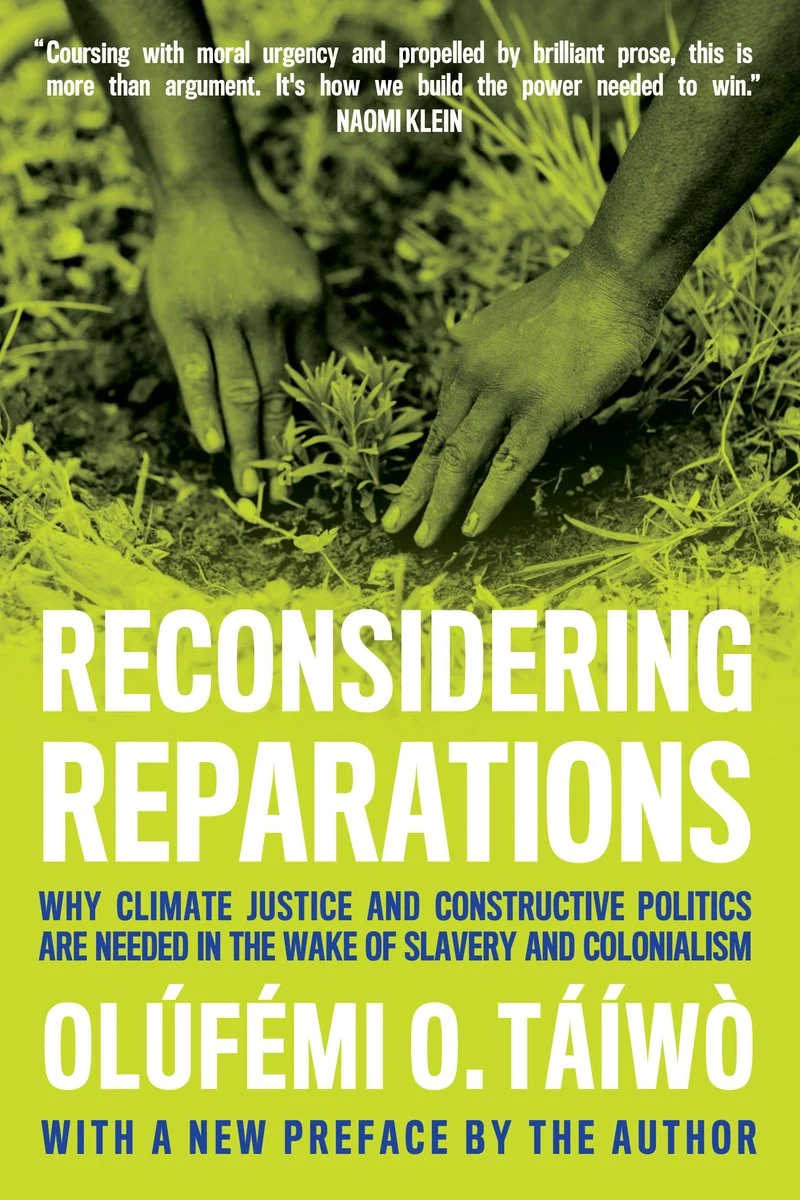
        <h2><em>Reconsidering Reparations</em> by
    Olúfémi O. Táíwò
    (Haymarket Books, 2022)</h2>
  <p><img src="https://aworkinglibrary.com/img/taiwo-reconsidering-reparations.jpg"/></p>
  <p>Beginning with the assertion that the transatlantic slave trade and the colonialism it enabled were unprecedented not in their immorality but in their <em>scale,</em> Olúfémi O. Táíwò argues that undoing that injustice requires we mount an effort to remake the world at the same scale—i.e., that we embark on a project of worldmaking. This is what he terms the <em>constructive</em> form of reparations: distributive justice that looks to the past to construct a transition from the global racial empire we have today to the more just world we wish to arrive at tomorrow—and beyond. Critically, this is a view of reparations and social justice that is entangled with climate justice, for we cannot achieve the former without the latter. There is of course no easy path here. It took generations to build this world, and it will take generations to build the next. Which is all the more reason to start, today.</p>
  <hr/>
  <p><em><a href="https://aworkinglibrary.com/reading/reconsidering-reparations">View this post on the web</a>, <a href="https://aworkinglibrary.com/subscribe/">subscribe to the newsletter</a>, or <a href="mailto:mandy@aworkinglibrary.com?subject=Re: Reconsidering Reparations">reply via email</a>.</em></p>
  ]]>
</content>
<summary type="html"><![CDATA[Olúfémi O. Táíwò argues for a *constructive* form of reparations: distributive justice that looks to the past to construct a transition from the global racial empire we have today to the more just world we wish to arrive at tomorrow—and beyond.]]></summary>
</entry>
<entry>
  <title>The Shapeless Unease</title>
  <id>https://aworkinglibrary.com/reading/shapeless-unease</id>
  <link href="https://aworkinglibrary.com/reading/shapeless-unease"/>
  <updated>2026-05-04T09:07:00-04:00</updated>
  <content type="html"><![CDATA[
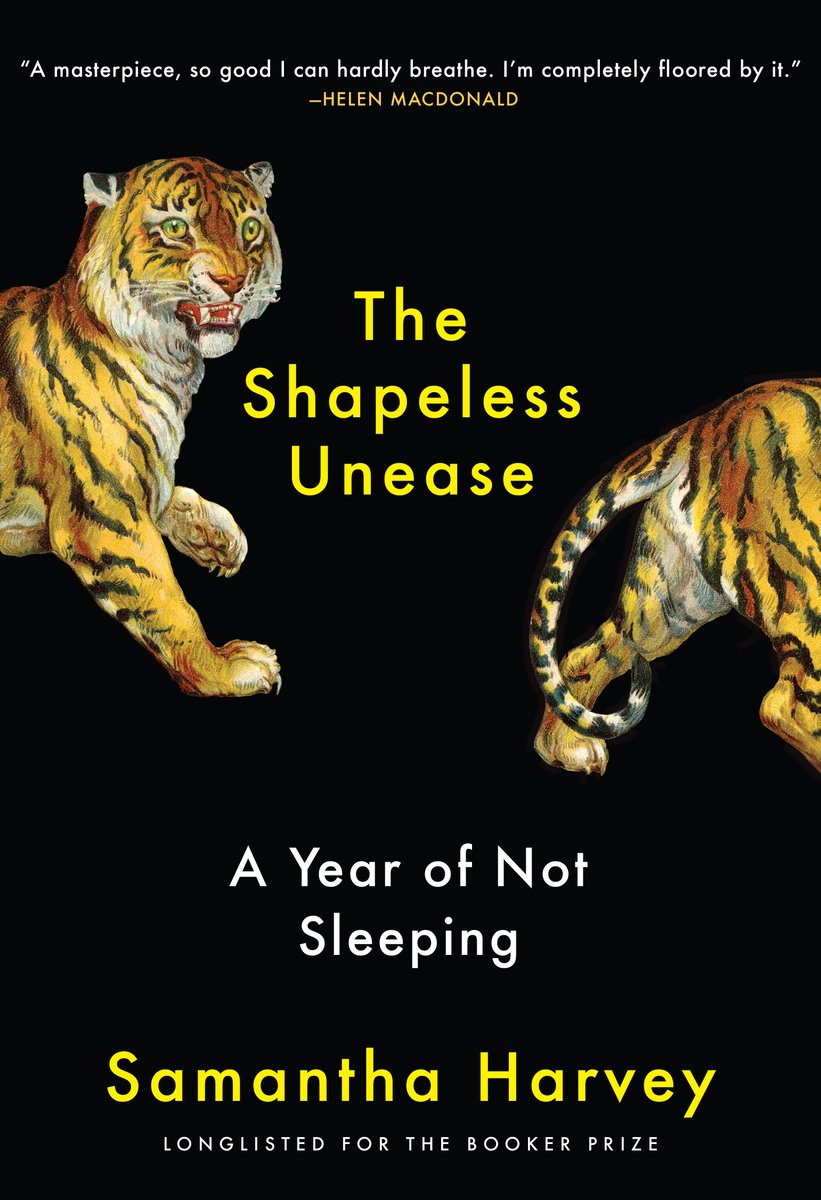
        <h2><em>The Shapeless Unease</em> by
    Samantha Harvey
    (Grove Press, 2020)</h2>
  <p><img src="https://aworkinglibrary.com/img/harvey-shapeless-unease.jpg"/></p>
  <p>Struck by the sudden and untimely death of her cousin, and distressed by the terrible political order, Samantha Harvey finds that she cannot sleep. There is nothing wrong with her, or there is everything wrong with her, or there is everything wrong in the world—in the grief that has passed and in all the grief that is yet to come. Mordant and morbid, suffused with anxiety, <em>The Sleepless Unease</em> is as much a meditation on being in a world marked by intolerable uncertainty, global-scale grift, and constant noise as it is about that most basic human need. A worthwhile companion on many a sleepless night.</p>
  <hr/>
  <p><em><a href="https://aworkinglibrary.com/reading/shapeless-unease">View this post on the web</a>, <a href="https://aworkinglibrary.com/subscribe/">subscribe to the newsletter</a>, or <a href="mailto:mandy@aworkinglibrary.com?subject=Re: The Shapeless Unease">reply via email</a>.</em></p>
  ]]>
</content>
<summary type="html"><![CDATA[Struck by the sudden and untimely death of her cousin, and distressed by the terrible political order, Samantha Harvey finds that she cannot sleep.]]></summary>
</entry>
<entry>
  <title>The “correct” attitude</title>
  <id>https://aworkinglibrary.com/writing/correct-attitude</id>
  <link href="https://aworkinglibrary.com/writing/correct-attitude"/>
  <updated>2026-04-30T06:46:00-04:00</updated>
  <content type="html"><![CDATA[


        <p>In one layoff announcement after another, we hear that AI can now do the work of a great many people, which is why far fewer people are needed to do the work. If, for the moment, we take that assertion at face value, this still leaves an obvious alternative path: instead of reducing the number of workers, companies could reduce the amount of <em>working time</em>. That is, rather than laying off twenty percent of the workforce, they could have everyone work twenty percent less. In fact, I’d venture that a great number of <a href="https://aworkinglibrary.com/writing/knowledge-workers">knowledge workers</a> would be more than happy to take a twenty percent pay cut in exchange for a four-day work week.<sup id="fnref:1"><a href="#fn:1" class="footnote" rel="footnote" role="doc-noteref">1</a></sup> Time is very often more valuable than cash.</p>
  <p>But the steady drumbeat of layoffs suggests that no member of the C-suite has even considered this path. Why not?</p>
  <blockquote>
    <p>It could hardly be more clearly stated that the workers taken in by the big companies are a small “elite,” not because they have higher levels of skill, but because they have been chosen from a mass of equally able individuals in such a way as to perpetuate the work ethic in an economic context in which work is objectively losing its “centrality”: the economy has less and less need of it. The passion for, devotion to, and identification with work would be diminishing if everyone were able to work less and less. It is economically more advantageous to concentrate the small amount of necessary work in the hands of a few, who will be imbued with the sense of being a deservedly privileged elite by virtue of the eagerness which distinguishes them from the “losers.” Technically, there really is nothing to prevent the firm from sharing out the work between a larger number of people who would work only 20 hours a week. But then those people would not have the “correct” attitude to work which consists in regarding themselves as small entrepreneurs turning their knowledge capital to good effect.</p>
    <p><cite><a href="https://aworkinglibrary.com/reading/reclaiming-work">Gorz, <em>Reclaiming Work,</em> page 45</a></cite></p>
  </blockquote>
  <p>Gorz is writing more than two decades before the current crop of LLMs hit the market, but of course the seeds of our present predicament were planted long ago: in the years before the dot-com crash, we also saw a small number of privileged people earning large sums of money while working egregiously long hours in overpriced but ostensibly comfortable chairs.</p>
  <p>Perhaps if something is different now it’s the scale of the threat: in the years since that first tech bubble, the number of tech and tech-adjacent jobs have soared. Meanwhile, the leaders of tech companies today claim that AI will take <em>all</em> the work away, that no job is safe. It is hard to maintain the “correct” attitude to work in light of such apocalyptic claims. Which begs the question, what attitude is taking its place? What happens when we no longer see ourselves as “small entrepreneurs”? We’re on our way to finding out. </p>
  <div class="footnotes" role="doc-endnotes">
    <ol>
      <li id="fn:1">
        <p>Of course, from a labor perspective, the demand should be a <a href="https://www.npr.org/2023/09/11/1198394085/uaw-big-3-automakers-4-day-work-week-shawn-fain-detroit">four day workweek at full pay</a>. <a href="#fnref:1" class="reversefootnote" role="doc-backlink">&#8617;&#xfe0e;</a></p>
      </li>
    </ol>
  </div>
  <hr/>
  <p><em><a href="https://aworkinglibrary.com/writing/correct-attitude">View this post on the web</a>, <a href="https://aworkinglibrary.com/subscribe/">subscribe to the newsletter</a>, or <a href="mailto:mandy@aworkinglibrary.com?subject=Re: The “correct” attitude">reply via email</a>.</em></p>
  ]]>
</content>
<summary type="html"><![CDATA[In one layoff announcement after another, we hear that AI can now do the work of a great many people, which is why fewer people are needed to do the work.]]></summary>
</entry>
<entry>
  <title>The Third Reich of Dreams</title>
  <id>https://aworkinglibrary.com/reading/third-reich-of-dreams</id>
  <link href="https://aworkinglibrary.com/reading/third-reich-of-dreams"/>
  <updated>2026-04-29T15:57:00-04:00</updated>
  <content type="html"><![CDATA[
        <h2><em>The Third Reich of Dreams</em> by
    Charlotte Beradt
    (Princeton University Press, 1966, 2025)</h2>
  <p><img src="https://aworkinglibrary.com/img/beradt-third-reich-of-dreams.jpg"/></p>
  <p>In 1933, shortly after Hitler took power, Charlotte Beradt started having nightmares. Quietly, she asked friends and neighbors if they were experiencing the same, and soon began to build a collection of dreams. She was eventually able to smuggle her writing out of the country, and fled to New York, where she formed a community with other Jewish refugees. <em>The Third Reich of Dreams</em> was published nearly thirty years later, and records not only the dreams she collected, but her astute synthesis of the various tropes and images that recurred. Among her conclusions: totalitarianism must be named as such as soon as it appears, as soon as our dreams know of it. If we wait for it to reveal itself on its own terms, it will be too late.</p>
  <hr/>
  <p><em><a href="https://aworkinglibrary.com/reading/third-reich-of-dreams">View this post on the web</a>, <a href="https://aworkinglibrary.com/subscribe/">subscribe to the newsletter</a>, or <a href="mailto:mandy@aworkinglibrary.com?subject=Re: The Third Reich of Dreams">reply via email</a>.</em></p>
  ]]>
</content>
<summary type="html"><![CDATA[In 1933, shortly after Hitler took power, Charlotte Beradt started having nightmares.]]></summary>
</entry>
<entry>
  <title>Automation conformity</title>
  <id>https://aworkinglibrary.com/writing/automation-conformity</id>
  <link href="https://aworkinglibrary.com/writing/automation-conformity"/>
  <updated>2026-04-22T08:31:00-04:00</updated>
  <content type="html"><![CDATA[


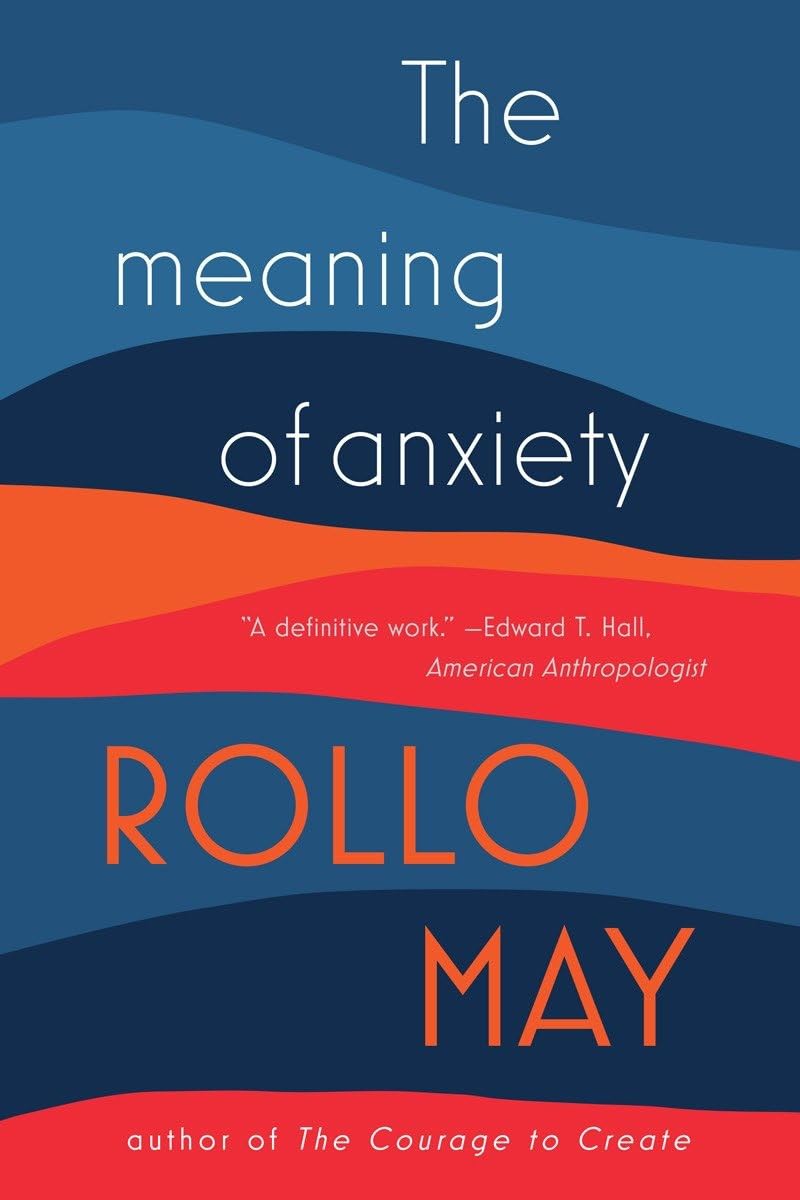
        <p>Rollo May asserts plainly in the opening pages of <em>The Meaning of Anxiety</em> that anxiety in fact <em>has</em> meaning, and that our aim cannot be to eliminate it but to work with it, and through it, to use it to propel our creativity and vigor for life. And yet, anxiety is often deeply, even intolerably, unpleasant, and the effort to embrace it can test us beyond our abilities. We are wont, then, to look for an escape hatch, an easy path to relief; but those paths always come with a cost.</p>
  <blockquote>
    <p>It is to be expected that certain “mechanisms of escape” from the situation of isolation and anxiety should have developed. The mechanism most frequently employed in our culture, [Erich] Fromm believes, is that of <em>automation conformity.</em> An individual “adopts entirely the kind of personality offered to him [<em>sic</em>] by cultural patterns; and he therefore becomes exactly as all others are and as they expect him to be.” This conformity proceeds on the assumption that the “person who gives up his individual self and becomes an automaton, identical with millions of other automatons around him, need not feel alone and anxious any more.”</p>
    <p><cite><a href="https://aworkinglibrary.com/reading/meaning-of-anxiety">May, <em>The Meaning of Anxiety</em>, page 180</a></cite></p>
  </blockquote>
  <p>It does not take a hard look to spot the evidence of this conformity in our own time. Millions of nearly identical LinkedIn posts, all saying the same thing, in the same jittery staccato, the same strained performance of revelation when in fact nothing at all is being revealed. (I am picking on LinkedIn here, but it is symptom of this phenomena, not the cause.) Worse, we now have chatbots who will produce and reproduce this pablum at scale, bringing a kind of double-edge to that conformity: we conform when we use those tools, when we accede to the assertion of their inevitability; and we conform <em>again</em> when we place them in our mouths and in our minds, when we outsource our speech and thinking to them. We become automatons twice over.</p>
  <p>Fromm and May here posit that when we make this trade, when we adopt those cultural patterns, we give up our unique selves in exchange for a relief of anxiety. In the light of our current drive for automation, I will make a counter proposal: we give up our unique selves <em>in the hope</em> that it will bring some relief, but that relief is ever deferred. For at present, becoming an automaton nearly guarantees that you will be left out to dry, as the promise of so-called AI is that the more you use it, the more <em>it</em> uses <em>you</em>. Such that in the act of becoming automatons, we bring ourselves that much closer to the thing we really fear: being left alone, without any of the care or materials we need to survive. We give up our individual selves for the <em>appearance</em> of security, without any of the conditions that can actually create it.</p>
  <p>This is the trap anxiety lays for us: in our effort to escape it, we run further into its jaws. But perhaps there are yet alternatives. May connects that impulse to escape with the experience of isolation: can we become less isolated without becoming automatons? Can we find community not in the center, but on the outskirts, among the weirdos and the outsiders, the people who never seem to fit in, who are always playing a different game? There are fewer of them, by definition, but not so few that we cannot find them. We won’t find the comfort of the majority among them, of course—but as we have seen, that comfort is mere illusion—but perhaps we can find the community and camaraderie that is so necessary for our survival, and without giving up our precious selves to get it. </p>
  <hr/>
  <p><em><a href="https://aworkinglibrary.com/writing/automation-conformity">View this post on the web</a>, <a href="https://aworkinglibrary.com/subscribe/">subscribe to the newsletter</a>, or <a href="mailto:mandy@aworkinglibrary.com?subject=Re: Automation conformity">reply via email</a>.</em></p>
  ]]>
</content>
<summary type="html"><![CDATA[In our effort to escape anxiety, we run further into its jaws.]]></summary>
</entry>
<entry>
  <title>The Meaning of Anxiety</title>
  <id>https://aworkinglibrary.com/reading/meaning-of-anxiety</id>
  <link href="https://aworkinglibrary.com/reading/meaning-of-anxiety"/>
  <updated>2026-04-22T08:30:00-04:00</updated>
  <content type="html"><![CDATA[
        <h2><em>The Meaning of Anxiety</em> by
    Rollo May
    (Norton, 1950)</h2>
  <p><img src="https://aworkinglibrary.com/img/may-meaning-of-anxiety.jpg"/></p>
  <p>Rollo May refutes the assertion that mental health is living <em>without</em> anxiety, proposing instead that anxiety is a necessary condition for creativity, intellect, and freedom. He defines anxiety as the “experience of Being affirming itself against Nonbeing,” as that which propels us to more self-awareness, consciousness, and life. He likewise shows that the refusal to embrace this anxiety, to attend to it and work with it and through it, is an invitation to authoritarianism and fascism. When we lack the skills of being with our anxiety, and feel our only option is to flee, we often flee right into the hands of a strongman who promises security at the cost of liberty. May wrote during the height of fascism in the last century; we read it during the renewal of the same in this one. The lessons hold.</p>
  <hr/>
  <p><em><a href="https://aworkinglibrary.com/reading/meaning-of-anxiety">View this post on the web</a>, <a href="https://aworkinglibrary.com/subscribe/">subscribe to the newsletter</a>, or <a href="mailto:mandy@aworkinglibrary.com?subject=Re: The Meaning of Anxiety">reply via email</a>.</em></p>
  ]]>
</content>
<summary type="html"><![CDATA[Rollo May refutes the assertion that mental health is living *without* anxiety, proposing instead that anxiety is a necessary condition for creativity, intellect, and freedom.]]></summary>
</entry>
<entry>
  <title>Orbital</title>
  <id>https://aworkinglibrary.com/reading/orbital</id>
  <link href="https://aworkinglibrary.com/reading/orbital"/>
  <updated>2026-04-20T19:53:00-04:00</updated>
  <content type="html"><![CDATA[
        <h2><em>Orbital</em> by
    Samantha Harvey
    (Grove Press, 2023)</h2>
  <p><img src="https://aworkinglibrary.com/img/harvey-orbital.jpg"/></p>
  <p>Six people—four astronauts and two cosmonauts—circle the Earth. They may be among the last to do so, as the space station they live in is due to be dismantled. While they circle and observe, watching sunrise after sunset, seeing typhoons and dust storms wash across the surface below, another crew of astronauts takes off for the moon, passing them by. But their gaze remains stubbornly down, not out; down into the water and land and lights, into their own memories and histories, the deaths and lives that keep them tethered as certainly as gravity prevents them from falling away. A moving love letter to our one and only planet.</p>
  <hr/>
  <p><em><a href="https://aworkinglibrary.com/reading/orbital">View this post on the web</a>, <a href="https://aworkinglibrary.com/subscribe/">subscribe to the newsletter</a>, or <a href="mailto:mandy@aworkinglibrary.com?subject=Re: Orbital">reply via email</a>.</em></p>
  ]]>
</content>
<summary type="html"><![CDATA[Six people—four astronauts and two cosmonauts—may be among the last to circle the Earth.]]></summary>
</entry>
<entry>
  <title>We</title>
  <id>https://aworkinglibrary.com/reading/we</id>
  <link href="https://aworkinglibrary.com/reading/we"/>
  <updated>2026-04-08T07:30:00-04:00</updated>
  <content type="html"><![CDATA[
        <h2><em>We</em> by
    Yevgeny Zamyatin
    (Ecco, 1920)</h2>
  <p><img src="https://aworkinglibrary.com/img/zamyatin-we.jpg"/></p>
  <p>In a glass-walled city ruled by the totalitarian One State, citizens have no privacy, no identity, no freedom, and no names: they each bear only a number. As they prepare to launch their first spaceship, <em>The Integral</em>, citizens are implored to write poems, treatises, and manifestos glorifying the One State and honoring this extraordinary time. D-503, the builder of <em>The Integral,</em> is not a writer, but he gamely takes up the challenge and discovers something quite shocking: he has a soul, a spirit, desires which exceed the container that the One State has set out for him, that make him long for something new. In the discovery of his own power of imagination is the greatest threat the One State will ever face—and his one chance for freedom.</p>
  <hr/>
  <p><em><a href="https://aworkinglibrary.com/reading/we">View this post on the web</a>, <a href="https://aworkinglibrary.com/subscribe/">subscribe to the newsletter</a>, or <a href="mailto:mandy@aworkinglibrary.com?subject=Re: We">reply via email</a>.</em></p>
  ]]>
</content>
<summary type="html"><![CDATA[In a glass-walled city ruled by the totalitarian One State, citizens have no privacy, no identity, no freedom, and no names: they each bear only a number.]]></summary>
</entry>
<entry>
  <title>Reformed</title>
  <id>https://aworkinglibrary.com/writing/reformed</id>
  <link href="https://aworkinglibrary.com/writing/reformed"/>
  <updated>2026-03-18T07:50:00-04:00</updated>
  <content type="html"><![CDATA[


        <p>We are, once again and inexplicably, seeing a conversation unfold about reforming the military force in our streets, with body cameras and training standing in for a moral reckoning about the kind of world we want to live in, the kind of world that is livable for more than the wealthy few. We know what such “reforms” accomplish, because we’ve seen this many times before: an armed, unaccountable force <em>with</em> body cameras is no less deadly or immoral than an armed, unaccountable force without. A trained secret police is still the secret police.</p>
  <p>A short walk from where I write this is the old <a href="https://en.wikipedia.org/wiki/Walnut_Street_Prison">Walnut Street Jail</a>, the first penitentiary built in the US, a precursor to the more infamous Eastern State Penitentiary, which was designed and operated by the Quakers. The Quakers advocated for reforms to the old prison systems, in which deprivation and corporal punishment were the norm, arguing that solitude, cleanliness, and discipline were better methods for rehabilitation. More than 200 years after those “reforms,” our prisons remain locations of intense deprivation, physical violence, coerced labor, and, frequently, inhumane solitary confinement—the “penitence” the Quakers were after still in short supply. <a href="https://www.aclu.org/news/immigrants-rights/detained-immigrants-detail-physical-abuse-and-inhumane-conditions-at-largest-immigration-detention-center-in-the-u-s">Reports</a> <a href="https://apnews.com/article/immigration-detention-medical-ice-food-ossoff-investigation-e218486607c04040c94561699e1d0054">from</a> <a href="https://www.wired.com/story/senate-probe-uncovers-widespread-abuse-in-ice-custody/">the detention centers</a> built today to house people pulled from the streets without due process shows that even those minimal standards are anything but: inedible food, overcrowding, lights on twenty-four hours a day, refusal of medical care, rape, and murder are all regular occurrences in these new prisons.</p>
  <p>This is the process that reform takes: the system is modified around the edges, often in ways that seem to cushion or obscure its real purpose, but the underlying conditions that maintain it remain unchanged. The old ways resurface, eventually.</p>
  <p>But if not reform, then what? What else can we do? André Gorz proposes a concept of “non-reformist reforms,” reforms which</p>
  <blockquote>
    <p>bring the future into the present…[that] make power tangible <em>now</em> by means of actions which demonstrate to the workers their positive strength.</p>
    <p><cite><a href="https://aworkinglibrary.com/reading/strategy-for-labor">Gorz, <em>A Strategy for Labor</em>, page 11</a></cite></p>
  </blockquote>
  <p>For Gorz, a reform is non-reformist if it both exercises the power and agency of workers acting together and foreshadows the future world in the present. That is, a non-reformist reform requires both concrete, bottoms-up action <em>and</em> the reflection of a different world within that action, the way a small fractal prefigures the large. Body cameras promise increased surveillance with no attendant increase in accountability, while training maintains the distribution of money and resources away from care and towards cops and prisons; both reforms represent business as usual, not a remade world. Only abolitionist demands—to defund militarized police forces in all their many forms, to invest instead in schools, libraries, homes, healthcare, childcare, and more—can both exercise that power <em>and</em> foreshadow a world where care overcomes criminalization.</p>
  <p>To put this another way: a reform maintains the old world, often under cover. While a non-reformist reform demands that we build a new world, one in which all humans and the more-than-human world can thrive.</p>
  <p>We must take small steps towards the future we want; there is no other way. But each step must point the way toward that future, a drop of water that heralds the wave. </p>
  <hr/>
  <p><em><a href="https://aworkinglibrary.com/writing/reformed">View this post on the web</a>, <a href="https://aworkinglibrary.com/subscribe/">subscribe to the newsletter</a>, or <a href="mailto:mandy@aworkinglibrary.com?subject=Re: Reformed">reply via email</a>.</em></p>
  ]]>
</content>
<summary type="html"><![CDATA[A trained secret police is still the secret police.]]></summary>
</entry>
<entry>
  <title>The Salt Eaters</title>
  <id>https://aworkinglibrary.com/reading/salt-eaters</id>
  <link href="https://aworkinglibrary.com/reading/salt-eaters"/>
  <updated>2026-03-14T11:52:00-04:00</updated>
  <content type="html"><![CDATA[
        <h2><em>The Salt Eaters</em> by
    Toni Cade Bambara
    (Vintage, 1980)</h2>
  <p><img src="https://aworkinglibrary.com/img/bambara-salt-eaters.jpg"/></p>
  <p>Velma Henry is brought before Minnie Ransom for a healing. Velma, an activist who has become cynical of the movement and especially of the egocentric men who attempt to lead it, has recently channeled her cynicism into cutting her wrists and placing her head in the oven. Alive, wrists bandaged, gown flapping open in the back, she sits before a dozen friends and neighbors as Velma and her spiritual guide Old Wife try to bring her back. The book centers on this moment, sweeping backwards and forwards and around the Southern town where each of these people live and work and hope for better days. The opening question lingers through every page, perhaps unanswerable, or perhaps only to be answered by the whole: “Are you sure, sweetheart, that you want to be well?”</p>
  <hr/>
  <p><em><a href="https://aworkinglibrary.com/reading/salt-eaters">View this post on the web</a>, <a href="https://aworkinglibrary.com/subscribe/">subscribe to the newsletter</a>, or <a href="mailto:mandy@aworkinglibrary.com?subject=Re: The Salt Eaters">reply via email</a>.</em></p>
  ]]>
</content>
<summary type="html"><![CDATA[“Are you sure, sweetheart, that you want to be well?”]]></summary>
</entry>
<entry>
  <title>Designed to be specialists</title>
  <id>https://aworkinglibrary.com/writing/designed-to-be-specialists</id>
  <link href="https://aworkinglibrary.com/writing/designed-to-be-specialists"/>
  <updated>2026-02-19T12:09:00-05:00</updated>
  <content type="html"><![CDATA[


        <p>All industries and disciplines, over time, direct people into greater and greater specialization. Those who have been working on the web since the beginning have been able to see this trend first hand, as the practices and systems grew ever more complicated and it became impossible for one person to hold it all in their head. We sometimes talk of this level of increasing complexity and specialization as inevitable or natural, when it’s neither. Moreover, like many things involving work, specialization benefits some people and immiserates others.</p>
  <blockquote>
    <p>[There is an] extreme human and cultural misery to which not only the industry of advanced capitalism but above all its institutions, its education and its culture, have reduced the technical worker. This education, in its efforts to adapt the worker to his task in the shortest possible time, has given him the capacity for a minimum of independent activity. Out of fear of creating men [<em>sic</em>] who by virtue of the too “rich” development of their abilities would refuse to submit to the discipline of a too narrow task and to the industrial hierarchy, the effort has been made to stunt them from the beginning: they were designed to be competent but limited, active but docile, intelligent but ignorant outside of anything but their function, incapable of having a horizon beyond that of their task. In short, they were designed to be specialists.</p>
    <p><cite><a href="https://aworkinglibrary.com/reading/strategy-for-labor">Gorz, <em>A Strategy for Labor</em>, page 106</a></cite></p>
  </blockquote>
  <p>Impossible not to think here of the rise of labor unions in the tech industry and the subsequent rapid (and surely coincidental) deployment of so-called AI which—unlike nearly every prior technological development in software—arrived with mandates for its use and threats of punishment for the noncompliant. Elsewhere, Gorz talks of the trend of workers being reduced to “supervisors” of automated systems that are doing the work for them. But simply watching work happen, without any of the creative, autonomous activity that would occur if they were doing the work themselves, gives rise to a degree of boredom and stupefaction that can be physically painful and spiritually debilitating. Anyone who has experienced the pleasure of creative work is likely to greatly resist that reduction; better to create workers who have never known such things.</p>
  <p>There’s some use in distinguishing here between the worker who, having learned the skills of writing software over many years, now turns to so-called AI to assist her in that task; and the worker who will follow her some years hence and may never learn those skills, but will know only the work of supervision. The former, elder worker may find some interest or curiosity in applying her knowledge to this new technology, especially as the modes and methods for doing so are still being developed. But what of the worker who begins their work a decade from now, who has been specialized to do nothing more than ask for something? What will she know beyond that menial, dispiriting little task? What kind of people are we designing now? </p>
  <hr/>
  <p><em><a href="https://aworkinglibrary.com/writing/designed-to-be-specialists">View this post on the web</a>, <a href="https://aworkinglibrary.com/subscribe/">subscribe to the newsletter</a>, or <a href="mailto:mandy@aworkinglibrary.com?subject=Re: Designed to be specialists">reply via email</a>.</em></p>
  ]]>
</content>
<summary type="html"><![CDATA[What kind of people are we designing now?]]></summary>
</entry>
<entry>
  <title>The Waves</title>
  <id>https://aworkinglibrary.com/reading/waves</id>
  <link href="https://aworkinglibrary.com/reading/waves"/>
  <updated>2026-02-18T06:23:00-05:00</updated>
  <content type="html"><![CDATA[
        <h2><em>The Waves</em> by
    Virginia Woolf
    (Mariner Books, 1931)</h2>
  <p><img src="https://aworkinglibrary.com/img/woolf-waves.webp"/></p>
  <p>Six children—three girls and three boys—play in a garden by the sea. We follow them as they grow up, go to school, venture away from home, grieve the death of a friend, marry (or not), have children (or not). We do not see or hear their goings on but rather their inner monologues, the thoughts they could never have spoken but feel and know. More prose poem than novel, the writing posits that our inner lives are as rich and detailed as the world around us, perhaps more so. And that there is a continuity threaded through the differences and separations between us, a simultaneous distinctness and blurring of selves, both wave and particle, each headed for the shore.</p>
  <hr/>
  <p><em><a href="https://aworkinglibrary.com/reading/waves">View this post on the web</a>, <a href="https://aworkinglibrary.com/subscribe/">subscribe to the newsletter</a>, or <a href="mailto:mandy@aworkinglibrary.com?subject=Re: The Waves">reply via email</a>.</em></p>
  ]]>
</content>
<summary type="html"><![CDATA[Six children—three girls and three boys—play in a garden by the sea.]]></summary>
</entry>
<entry>
  <title>Pseudo-culture</title>
  <id>https://aworkinglibrary.com/writing/pseudo-culture</id>
  <link href="https://aworkinglibrary.com/writing/pseudo-culture"/>
  <updated>2026-02-12T07:38:00-05:00</updated>
  <content type="html"><![CDATA[


        <p>Our present-day realm of state terror operates through abductions, murders, and content farms. ICE workers raise their cameras as often as they raise their guns, decked out in military gear like a kid trying on mom’s heels, camo stark against the snow, while their bosses confuse retweets for votes, likes for being liked. Don Moynihan dubs this a “<a href="https://donmoynihan.substack.com/p/life-under-a-clicktatorship">clicktatorship</a>,” a cursed word if there ever was one, no less for being accurate. André Gorz, writing more than half a century earlier, terms this “pseudo-culture,” a counterfeit culture that does not arise out of ways of living but seeks to impose itself upon it.</p>
  <blockquote>
    <p>Mass pseudo-culture, while producing passive and stupefying entertainments, amusements, and pastimes, does not and cannot satisfy the needs arising out of dispersion, solitude, and boredom. This pseudo-culture is less a consequence than a cause of the passivity and the impotence of the individual in a mass society. It is a device invented by monopoly capital to facilitate dictatorship over a mystified, docile, debased humanity, whose impulse of real violence must be redirected into imaginary channels.</p>
    <p><cite><a href="https://aworkinglibrary.com/reading/strategy-for-labor">Gorz, <em>A Strategy for Labor</em>, page 94</a></cite></p>
  </blockquote>
  <p>That is, the tractable audience does not give rise to the clictatorshop so much as the reverse; <em>The Apprentice</em> precedes the presidency. The programming creates a subject whose anger at billionaires who dominate and oppress is redirected towards immigrants who do neither. Fantastical stories are projected onto real bodies as they are dragged out of their homes. The placated, brainrotted viewer is expected to see only the projection, to imagine themselves into the role of kevlar-swaddled goon, even as they flop onto the couch in cheap sweats, furiously tapping buttons, the only muscles getting exercised the ones in their thumbs.</p>
  <blockquote>
    <p>Mass culture, a byproduct of commercial propaganda, has as implicit content a mass ethic: playing on, maintaining, and flattering ignorance, it encourages the ignorant to resent those who “know,” persuades them that the latter despises them, and encourages or provokes their contempt. This abject demagogy, one of whose elements—contempt for “intellectuals,” (a term which has become an insult not only in the US) and for culture—can be found in all fascist movements, professes no respect for exceptional individuals except insofar as their superiority can be accounted for by what they <em>are,</em> not by what they <em>do</em>: athletes, beauty queens, princely personages. This is because the superiority of <em>being,</em> physical or hereditary, can be taken as a product of the nature—of the soil, the race, the people, the nation—from which all individuals derive, and can thus reflect to them a natural bond of community with the hero, their own vicarious aristocracy, their original identity, reproclaimed in chauvinism.</p>
    <p><cite><a href="https://aworkinglibrary.com/reading/strategy-for-labor">Gorz, <em>A Strategy for Labor</em>, page 118</a></cite></p>
  </blockquote>
  <p>Into this model is planted the vacuous chatbot, which both further denigrates knowing (why bother knowing anything when it can know things for you) and pumps out nonsense on the regular and at such a scale that both knowledge and the skill of knowing are drowned out. What’s left are the signals of superiority, cast in both skin and hip, recast with fillers and leg-lengthening surgeries, because nature can’t be trusted either (she’s a woman, after all). All in service to chauvinism, a word whose original meaning was an absurd devotion to a fallen leader.</p>
  <p>The observers who bravely record a different perspective, not only a different camera angle, but a different intention and context, show us that there are other ways of seeing, other ways of being. They dash through the fourth wall, make plain that we are not merely audience but actor, as much able to take up space on stage as the masked extras parading before them. It’s not their cameras that do this work, although those are useful, but their minds, their spirits, their fierce hearts. Their belief that they can see and know what is before them, that they don’t need to be told what is happening but—when they lift their gaze away from their screens—can trust their own eyes. </p>
  <hr/>
  <p><em><a href="https://aworkinglibrary.com/writing/pseudo-culture">View this post on the web</a>, <a href="https://aworkinglibrary.com/subscribe/">subscribe to the newsletter</a>, or <a href="mailto:mandy@aworkinglibrary.com?subject=Re: Pseudo-culture">reply via email</a>.</em></p>
  ]]>
</content>
<summary type="html"><![CDATA[Trust your own eyes.]]></summary>
</entry>
<entry>
  <title>A Strategy for Labor</title>
  <id>https://aworkinglibrary.com/reading/strategy-for-labor</id>
  <link href="https://aworkinglibrary.com/reading/strategy-for-labor"/>
  <updated>2026-02-12T07:35:00-05:00</updated>
  <content type="html"><![CDATA[
        <h2><em>A Strategy for Labor</em> by
    André Gorz
    (Beacon Press, 1964)</h2>
  <p><img src="https://aworkinglibrary.com/img/gorz-strategy-for-labor.jpg"/></p>
  <p>“A system that makes people work like zombies to produce useless, destructive, or self-destructive things has outlived its usefulness.” How to rouse people to defeat that system (i.e. capitalism) and build something better in its place, is the question André Gorz applies himself to here. Among his proposals is that of “non-reformist reform,” not reformism as a kind of gradualism or incrementalism—in which changes to the system are absorbed and reframed while the system carries on—but one that looks to that longed-for future and foreshadows its existence in the present. The strategy is echoed in the contemporary prison abolition movement, which refuses to be distracted by placating reforms that maintain an unequal balance of power. That his book is still relevant is our misfortune and our counsel all the same.</p>
  <hr/>
  <p><em><a href="https://aworkinglibrary.com/reading/strategy-for-labor">View this post on the web</a>, <a href="https://aworkinglibrary.com/subscribe/">subscribe to the newsletter</a>, or <a href="mailto:mandy@aworkinglibrary.com?subject=Re: A Strategy for Labor">reply via email</a>.</em></p>
  ]]>
</content>
<summary type="html"><![CDATA[“A system that makes people work like zombies to produce useless, destructive, or self-destructive things has outlived its usefulness.”]]></summary>
</entry>
<entry>
  <title>Patient urgency</title>
  <id>https://aworkinglibrary.com/writing/patient-urgency</id>
  <link href="https://aworkinglibrary.com/writing/patient-urgency"/>
  <updated>2026-01-22T09:22:00-05:00</updated>
  <content type="html"><![CDATA[


        <p>“Again and again,” writes Hannah Proctor,</p>
  <blockquote>
    <p>I kept coming to the same conclusion, which provides no consolation at all: psychological experiences require patience while so much in the world demands urgency.</p>
    <p><cite><a href="https://aworkinglibrary.com/reading/burnout">Proctor, <em>Burnout</em>, page 205</a></cite></p>
  </blockquote>
  <p>Proctor calls this quality “patient urgency,” and returns to it throughout her work on burnout—a work that retrieves burnout from the skincare industrial complex and brings it back to a dialogue about how our efforts to change the world are so often, and so cruelly, defeated. She is admirably unwilling to define the phrase in tactical terms, calling it only,</p>
  <blockquote>
    <p>a sense of urgency for social transformation that can tolerate difficulties, differences, delay, objective gaps, and interpersonal strains.</p>
    <p><cite><a href="https://aworkinglibrary.com/reading/burnout">Proctor, <em>Burnout</em>, page 156</a></cite></p>
  </blockquote>
  <p>Importantly, this does not mean simply waiting about for social transformation—that old refrain that progress will happen in time, as if time was an ally working on our behalf. The urgency is in the present moment to act, even as we know those actions will need time to bear fruit, even when it’s unclear how or if they may do so. As I’ve sat with the idea, I’ve thought more and more of planting a tree: you need to plant it at the right time and in the right place, make sure it has enough water and light and compost, protect it from pests and people, but you must wait years for the first peach. Nothing will hurry it along.</p>
  <p>And really, you ought to plant a whole grove, or scatter seeds about wherever you can, without ever knowing which ones will be trampled or lost to drought or wind, and which ones will, against the odds, grow tall and strong and true. To have patient urgency is, I think, to know that you must plant those seeds, that <a href="https://aworkinglibrary.com/writing/common-future">you must prepare the soil</a>, that these things cannot wait. That the future we hope for waits upon us, today. </p>
  <hr/>
  <p><em><a href="https://aworkinglibrary.com/writing/patient-urgency">View this post on the web</a>, <a href="https://aworkinglibrary.com/subscribe/">subscribe to the newsletter</a>, or <a href="mailto:mandy@aworkinglibrary.com?subject=Re: Patient urgency">reply via email</a>.</em></p>
  ]]>
</content>
<summary type="html"><![CDATA[“Psychological experiences require patience while so much in the world demands urgency.”]]></summary>
</entry>
<entry>
  <title>The Cancer Journals</title>
  <id>https://aworkinglibrary.com/reading/cancer-journals</id>
  <link href="https://aworkinglibrary.com/reading/cancer-journals"/>
  <updated>2026-01-21T08:17:00-05:00</updated>
  <content type="html"><![CDATA[
        <h2><em>The Cancer Journals</em> by
    Audre Lorde
    (Penguin, 1980)</h2>
  <p><img src="https://aworkinglibrary.com/img/lorde-cancer-journals.webp"/></p>
  <p>Between 1978 and 1980, Audre Lorde wrote about her experience with breast cancer and mastectomy, connecting her trials and treatment to her own work and to the collective effort of liberation for all women. She bears a great deal of anger towards a medical system that prioritizes cosmetics and prosthetics at the cost of women’s ability to face their own mortality and vulnerability, to live considered lives. She locates a kind of regressive nostalgia in that effort, in turning women ever back to what they cannot return to, rather than supporting the difficult but necessary journey ahead. Lorde refused to turn back, and in doing so, charted a path for all of us to follow.</p>
  <hr/>
  <p><em><a href="https://aworkinglibrary.com/reading/cancer-journals">View this post on the web</a>, <a href="https://aworkinglibrary.com/subscribe/">subscribe to the newsletter</a>, or <a href="mailto:mandy@aworkinglibrary.com?subject=Re: The Cancer Journals">reply via email</a>.</em></p>
  ]]>
</content>
<summary type="html"><![CDATA[Between 1978 and 1980, Audre Lorde wrote about her experience with breast cancer and mastectomy, connecting her trials and treatment to her own work and to the collective effort of liberation for all women.]]></summary>
</entry>
<entry>
  <title>Loss of an ideal</title>
  <id>https://aworkinglibrary.com/writing/loss-of-an-ideal</id>
  <link href="https://aworkinglibrary.com/writing/loss-of-an-ideal"/>
  <updated>2026-01-15T06:49:00-05:00</updated>
  <content type="html"><![CDATA[


        <p>The word “burnout” has taken on so many meanings, become a kind of casual and generic refrain that seems to apply to everyone all the time, a condition of  malaise and overwork that afflicts whole generations. But when first conceived the term had a more specific connotation.</p>
  <blockquote>
    <p>Burnout in Freudenberger’s articles from this period is not just defined in terms of physical tiredness as a result of doing too many things; rather, it emerges from emotional investment in a cause and from the disappointments that arise when flaws in a political project become apparent. Freudenberger’s concept not only describes physical exhaustion but also acknowledges the need to deal with anger caused by grief brought about by the “loss of an ideal.” Burnout in the context of social justice projects thus often involves a process of mourning, according to Freudenberger. Returning to his earlier writings on burnout makes it clear that when understood as a malaise arising from politically committed activities, burnout cannot be equated with tiredness or stress.</p>
    <p><cite><a href="https://aworkinglibrary.com/reading/burnout">Proctor, <em>Burnout</em>, page 92</a></cite></p>
  </blockquote>
  <p>In other words, burnout was defined more in the context of what Hannah Proctor terms the emotional experience of political defeat. Exhaustion was a component of that experience, marked also by the grief, anger, resentment, and despair that arises when an effort to create meaningful change is frustrated. Herbert J. Freudenberger, one of the early theorists of burnout, drew from his own observations working with patients at the St. Mark’s Free Clinic in New York City in the 70s and 80s. But as he and others worked with the term, it transformed into something else:</p>
  <blockquote>
    <p>While in 1974 Freudenberger claimed that those most at risk of burning out were “the dedicated and the committed,” by 1989 he linked burnout to “the externally imposed societal values of achievement, acquisition of goods, power, monetary compensation and competition.” Burnout shifted its meaning: from a symptom experienced by people struggling to change society to one experienced by people trying too hard to succeed within it.</p>
    <p><cite><a href="https://aworkinglibrary.com/reading/burnout">Proctor, <em>Burnout</em>, page 94</a></cite></p>
  </blockquote>
  <p>This shift also shows up in Byung-Chul Han’s <a href="https://aworkinglibrary.com/reading/burnout-society">writing about burnout</a>, in which the source of burnout is an “achievement society” that drives people towards a reflexive and all-consuming self-exploitation. But notice how that shift works: where before the notion of burnout was located within a communal and political project, now it becomes something we’re doing to ourselves, absent the still unchanged political and material conditions which gave rise to the original term. There’s a kind of commodification of burnout here, transferring the subject of burnout (and so of sympathy and potential support) from activists to executives, and the source from intolerable inequities to personal psychologies. Which is not to say that burned-out executives don’t exist, but that the use of the same word for two entirely different circumstances serves to undermine the political critique inherent in the word.</p>
  <p>The move is akin to the one made when imposter <em>phenomena</em> became <a href="https://everythingchanges.us/blog/impostered/">imposter <em>syndrome</em></a>: where the former concerns an experience in the world (“phenomenon” meaning a thing which can be seen or observed), the latter is an invisible pathology, something that only occurs within someone’s psyche and is, to a large extent, their own problem to solve. The disparities of the system become internalized, the therapeutics personalized, the victims pathologized. And the system keeps doing what the system does.</p>
  <p><a href="https://jewishcurrents.org/edifice-complex">Bench Ansfield writes</a> that Freudenberger borrowed the word burnout from his patients, who used it to describe someone suffering the long term effects of chronic drug use. But Freudenberger turned the word around, associating it not with drug use but with the burned out buildings that then peppered the Lower East Side, a neighborhood terrorized by landlords setting fire to their own buildings, eager for an insurance payout and happy to let their Black and brown tenants pay the price. “But it’s actually quite telling that Freudenberger saw himself and his burned-out coworkers as akin to burned-out buildings,” Ansfield writes. “Though he didn’t acknowledge it in his own exploration of the term, those torched buildings had generated value by being destroyed.” </p>
  <hr/>
  <p><em><a href="https://aworkinglibrary.com/writing/loss-of-an-ideal">View this post on the web</a>, <a href="https://aworkinglibrary.com/subscribe/">subscribe to the newsletter</a>, or <a href="mailto:mandy@aworkinglibrary.com?subject=Re: Loss of an ideal">reply via email</a>.</em></p>
  ]]>
</content>
<summary type="html"><![CDATA[From phenomena to pathology.]]></summary>
</entry>
<entry>
  <title>Burnout</title>
  <id>https://aworkinglibrary.com/reading/burnout</id>
  <link href="https://aworkinglibrary.com/reading/burnout"/>
  <updated>2026-01-15T06:45:00-05:00</updated>
  <content type="html"><![CDATA[
        <h2><em>Burnout</em> by
    Hannah Proctor
    (Verso, 2024)</h2>
  <p><img src="https://aworkinglibrary.com/img/proctor-burnout.jpg"/></p>
  <p>Hannah Proctor visits the concept of burnout not only as the sense of exhaustion and apathy that we commonly associate with it, but as the experience of political defeat—the disappointment, despair, and grief that emerges when one becomes aware that the political project they have committed themselves to may not succeed. This version of burnout can’t be entirely resolved by rest or self-care that limits itself to the personal, but requires attention and consideration of public and communal practices,  movements, and militancies. That is, recovery from political defeat is itself a political process. She argues for anti-adaptive healing—not healing that adapts the wounded to a broken world, but healing that transforms both the injured and the injurer, that looks to the possibility of a different world amidst the ruins of the present one.</p>
  <hr/>
  <p><em><a href="https://aworkinglibrary.com/reading/burnout">View this post on the web</a>, <a href="https://aworkinglibrary.com/subscribe/">subscribe to the newsletter</a>, or <a href="mailto:mandy@aworkinglibrary.com?subject=Re: Burnout">reply via email</a>.</em></p>
  ]]>
</content>
<summary type="html"><![CDATA[Hannah Proctor visits the concept of burnout as the experience of political defeat—the disappointment, despair, and grief that emerges when one becomes aware that the political project they have committed themselves to may not succeed.]]></summary>
</entry>
<entry>
  <title>Sisters of the Yam</title>
  <id>https://aworkinglibrary.com/reading/sisters-of-the-yam</id>
  <link href="https://aworkinglibrary.com/reading/sisters-of-the-yam"/>
  <updated>2026-01-15T06:30:00-05:00</updated>
  <content type="html"><![CDATA[
        <h2><em>Sisters of the Yam</em> by
    bell hooks
    (South End Press, 1993)</h2>
  <p><img src="https://aworkinglibrary.com/img/hooks-sisters-of-the-yam.jpg"/></p>
  <p>bell hooks explores notions of self-care among communities of Black women, locating it alongside the work of grief, testimony, and reconciliation. Where so much of the self-care discourse is oriented around personal solutions to personal problems, hooks looks instead to practices of collective care and truth-telling that work to dismantle systems of oppression and domination. This is a communal, political, and radical approach to self-care, a corrective to the consumerized discourse of self-care that brings little relief and leaves the world unchanged.</p>
  <hr/>
  <p><em><a href="https://aworkinglibrary.com/reading/sisters-of-the-yam">View this post on the web</a>, <a href="https://aworkinglibrary.com/subscribe/">subscribe to the newsletter</a>, or <a href="mailto:mandy@aworkinglibrary.com?subject=Re: Sisters of the Yam">reply via email</a>.</em></p>
  ]]>
</content>
<summary type="html"><![CDATA[bell hooks approaches notions of self-care among communities of Black women, locating it within the work of grief, testimony, and reconciliation.]]></summary>
</entry>
<entry>
  <title>Tyrannies and servilities</title>
  <id>https://aworkinglibrary.com/writing/tyrannies-and-servilities</id>
  <link href="https://aworkinglibrary.com/writing/tyrannies-and-servilities"/>
  <updated>2026-01-06T07:24:00-05:00</updated>
  <content type="html"><![CDATA[


        <p>In an effort to understand the then-present state of women in the workplace, Virginia Woolf goes looking to the newspapers, where she finds a number of letters and articles declaiming that women have too much liberty, that they are taking jobs that men could do, and that they are neglecting their domestic duties in the process. She finds an immediate parallel to those complaints in other events of the day:</p>
  <blockquote>
    <p>There, in those quotations, is the egg of the very same work that we know under other names in other countries. There we have in embryo the creature, Dictator as we call him when he is Italian or German, who believes that he has the right whether given by God, Nature, sex or race is immaterial, to dictate to other human beings how they shall live; what they shall do. Let us quote again: “Homes are the real places of the women who are now compelling men to be idle. It is time the Government insisted upon giving work to more men, thus enabling them to marry the women they cannot now approach.” Place it beside another quotation: “There are two worlds in the life of the nation, the world of men and the world of women. Nature has done well to entrust the man with the care of his family and the nation. The woman’s world is her family, her husband, her children, and her home.” One is written in English, the other German. But where is the difference? Are they not both saying the same thing? Are they not both the voices of Dictators, whether they speak English or German, and are we not all agreed that the dictator when we meet him abroad is a very dangerous as well as a very ugly animal? And he is here among us, raising his ugly head, spitting his poison, small still, curled up like a caterpillar on a leaf, but in the heart of England. Is it not from this egg, to quote Mr Wells again, that “the practical obliteration of [our] freedom by Fascists or Nazis” will spring? </p>
    <p><cite><a href="https://aworkinglibrary.com/reading/room-of-ones-own-and-three-guineas">Woolf, <em>Three Guineas</em>, page 228</a></cite></p>
  </blockquote>
  <p>The first quotation is from the <em>Daily Telegraph</em>; the second is Hitler.</p>
  <p>(I would draw comparisons to the present moment, but they seem to draw themselves.)</p>
  <p>Woolf later concludes:</p>
  <blockquote>
    <p>It suggests that the public and the private worlds are inseparably connected; that the tyrannies and servilities of the one are the tyrannies and servilities of the other. </p>
    <p><cite><a href="https://aworkinglibrary.com/reading/room-of-ones-own-and-three-guineas">Woolf, <em>Three Guineas</em>, page 364</a></cite></p>
  </blockquote>
  <p>That is, the tyranny of government is the tyranny of the workplace is the tyranny of the home. Each begets and creates the other. But perhaps that also suggests the reverse: pull the thread on one, and watch as they all come undone. </p>
  <hr/>
  <p><em><a href="https://aworkinglibrary.com/writing/tyrannies-and-servilities">View this post on the web</a>, <a href="https://aworkinglibrary.com/subscribe/">subscribe to the newsletter</a>, or <a href="mailto:mandy@aworkinglibrary.com?subject=Re: Tyrannies and servilities">reply via email</a>.</em></p>
  ]]>
</content>
<summary type="html"><![CDATA[The tyranny of government is the tyranny of the workplace is the tyranny of the home.]]></summary>
</entry>
<entry>
  <title>Annals of the Western Shore</title>
  <id>https://aworkinglibrary.com/reading/annals-of-the-western-shore</id>
  <link href="https://aworkinglibrary.com/reading/annals-of-the-western-shore"/>
  <updated>2026-01-05T08:05:00-05:00</updated>
  <content type="html"><![CDATA[
        <h2><em>Annals of the Western Shore</em> by
    Ursula K. Le Guin
    (Library of America, 2004, 2006, 2007)</h2>
  <p><img src="https://aworkinglibrary.com/img/le-guin-annals-of-the-western-shore.jpg"/></p>
  <p>In these three short novels, Le Guin takes us to the Western Shore, where people of magic and people of war and people of books all try to make their lives together. In <em>Gifts</em>, a young man comes to terms with his family’s heritage, the terrible power of unmaking. In <em>Voices</em>, a girl finds shelter in a library that harbors a secret presence. And in <em>Power</em>, a child raised as a slave must walk the perilous path to freedom, as the visions he doesn’t understand show him the way. In each novel, the people make the halting, deadly, and difficult journey of liberty, never sure if they will make it, carried along by the greatest power and gift any of them will ever know—the story.</p>
  <hr/>
  <p><em><a href="https://aworkinglibrary.com/reading/annals-of-the-western-shore">View this post on the web</a>, <a href="https://aworkinglibrary.com/subscribe/">subscribe to the newsletter</a>, or <a href="mailto:mandy@aworkinglibrary.com?subject=Re: Annals of the Western Shore">reply via email</a>.</em></p>
  ]]>
</content>
<summary type="html"><![CDATA[In these three short novels, Le Guin takes us to the Western Shore, where people of magic and people of war and people of books all try to make their lives together.]]></summary>
</entry>
<entry>
  <title>What books are for</title>
  <id>https://aworkinglibrary.com/writing/what-books-are-for</id>
  <link href="https://aworkinglibrary.com/writing/what-books-are-for"/>
  <updated>2025-12-18T06:20:00-05:00</updated>
  <content type="html"><![CDATA[


        <p>In despair at a critical review, Virginia Woolf turned to her husband and asked,</p>
  <blockquote>
    <p>Well, then, what should she do about such abuse? Pay no attention, get on with her work. And if she couldn’t work, what then? If such attacks upset her so that she couldn’t write—what then, Mongoose, what then? Then she should read until she could write again; that’s what books were for. </p>
    <p><cite><a href="https://aworkinglibrary.com/reading/mitz">Nunez, <em>Mitz</em>, page 46</a></cite></p>
  </blockquote>
  <p>(“Mongoose” was the pet name Virginia used for Leonard; he called her “Mandrill.” <em>Mitz</em> is fiction, but it draws from the Woolf’s diaries and other contemporary sources and is, for my purposes, true enough. <a href="https://aworkinglibrary.com/writing/all-prose-is-fiction">All prose is fiction</a>, as Le Guin teaches us.)</p>
  <p>Virginia, of course, knew well the ways that reading could summon us to our own wills. Here a similar note is echoed in a passage in <em>A Room of One’s Own</em>:</p>
  <blockquote>
    <p>Nature seems, very oddly, to have provided us with an inner light by which to judge of the novelist’s integrity or disintegrity. Or perhaps it is rather that Nature, in her most irrational mood, has traced in invisible ink on the walls of the mind a premonition which these great artists confirm; a sketch which only needs to be held to the fire of genius to become visible. When one so exposes it and sees it come to life one exclaims in rapture, But this is what I have always felt and known and desired!</p>
    <p><cite><a href="https://aworkinglibrary.com/reading/room-of-ones-own-and-three-guineas">Woolf, <em>A Room of One’s Own</em>, page 94</a></cite></p>
  </blockquote>
  <p>This is one of the great joys of reading, and of reading novels in particular: that something in the novel resonates so deeply that you feel it vibrate down to your marrow, feel that spark of truth race across your veins. And that spark is, very often, a light by which we can write, the energy we need to put our own pen to paper, to evoke the fire that makes those premonitions visible, however darkly and briefly and tenuously.</p>
  <p>And yet: sometimes the words do not come. In <em>The Left Hand of Darkness,</em> Le Guin writes:</p>
  <blockquote>
    <p>As they say in Ekumenical School, when action grows unprofitable, gather information; when information grows unprofitable, sleep. </p>
    <p><cite><a href="https://aworkinglibrary.com/reading/left-hand-of-darkness">Le Guin, <em>The Left Hand of Darkness</em>, page 42</a></cite></p>
  </blockquote>
  <p>Which is another way of saying, when you can’t write, read. When you can’t read, sleep. </p>
  <hr/>
  <p><em><a href="https://aworkinglibrary.com/writing/what-books-are-for">View this post on the web</a>, <a href="https://aworkinglibrary.com/subscribe/">subscribe to the newsletter</a>, or <a href="mailto:mandy@aworkinglibrary.com?subject=Re: What books are for">reply via email</a>.</em></p>
  ]]>
</content>
<summary type="html"><![CDATA[When action grows unprofitable, gather information; when information grows unprofitable, sleep.]]></summary>
</entry>
<entry>
  <title>Searoad</title>
  <id>https://aworkinglibrary.com/reading/searoad</id>
  <link href="https://aworkinglibrary.com/reading/searoad"/>
  <updated>2025-12-15T07:13:00-05:00</updated>
  <content type="html"><![CDATA[
        <h2><em>Searoad</em> by
    Ursula K. Le Guin
    (Library of America, 1991)</h2>
  <p><img src="https://aworkinglibrary.com/img/le-guin-searoad.jpg"/></p>
  <p>This collection of interlocking stories tells of the people who live in a small town on the Oregon coast. They are young and old, hale and sick, some fleeing horrors and some looking for peace. Some have lived there all their lives, others are just passing through; still others leave and feel compelled to return. <em>Searoad</em> is in many ways a response to <a href="https://aworkinglibrary.com/author/virginia-woolf/">Virginia Woolf</a>: its women wonder about rooms of their own, and about war; its men wonder about the women. All the while, the ocean pounds against the coast, wave after wave after wave, scooping up sand and leaving messages in its wake for anyone attentive enough to hear.</p>
  <hr/>
  <p><em><a href="https://aworkinglibrary.com/reading/searoad">View this post on the web</a>, <a href="https://aworkinglibrary.com/subscribe/">subscribe to the newsletter</a>, or <a href="mailto:mandy@aworkinglibrary.com?subject=Re: Searoad">reply via email</a>.</em></p>
  ]]>
</content>
<summary type="html"><![CDATA[This collection of interlocking stories tells of the people who live in a small town on the Oregon coast.]]></summary>
</entry>
<entry>
  <title>Live at enmity with unreality</title>
  <id>https://aworkinglibrary.com/writing/live-at-enmity-with-unreality</id>
  <link href="https://aworkinglibrary.com/writing/live-at-enmity-with-unreality"/>
  <updated>2025-12-11T07:49:00-05:00</updated>
  <content type="html"><![CDATA[


        <p>“What is meant by ‘reality’?” asks Virginia Woolf:</p>
  <blockquote>
    <p>It would seem to be something very erratic, very undependable—now to be found in a dusty road, now in a scrap of newspaper in the street, now a daffodil in the sun. It lights up a group in a room and stamps some casual saying. It overwhelms one walking home beneath the stars and makes the silent world more real than the world of speech—and then there it is again in an omnibus in the uproar of Piccadilly. Sometimes, too, it seems to dwell in shapes too far away for us to discern what their nature is. But whatever it touches, it fixes and makes permanent. That is what remains over when the skin of the day has been cast into the hedge; that is what is left of past time and of our loves and hates. Now the writer, as I think, has the chance to live more than other people in the presence of this reality. It is his business to find it and collect it and communicate it to the rest of us. So at least I infer from reading <em>Lear</em> or <em>Emma</em> or <em>A la recherche du temps perdu.</em> For the reading of these books seems to perform a curious couching operation on the senses; one sees more intensely afterwards; the world seems bared of its covering and given an intenser life. Those are the enviable people who live at enmity with unreality; and those are the pitiable people who are knocked on the head by the thing done without knowing or caring. So that when I ask you to earn money and have a room of your own, I am asking you to live in the presence of reality, an invigorating life, it would appear, whether one can impart it or not.  </p>
    <p><cite><a href="https://aworkinglibrary.com/reading/room-of-ones-own-and-three-guineas">Woolf, <em>A Room of One’s Own</em>, page 143</a></cite></p>
  </blockquote>
  <p>Unreality here is not the imaginary or the fantastical—for these are what emerge from a living and real mind—but the manufactured and manipulative mirages that draw us away from our creative powers, the noisy illusions made to drown out our own perceptions and visions, that make it impossible to hear ourselves think. Reality, then, is that which heightens our awareness, attunes our consciousness to the living world so that we may resonate with it, so that we may experience the world as bare of its covering and in all its great intensity and vividness. To make unreality an enemy is to welcome reality as compatriot and comrade, as fellow in arms against a vacuousness that threatens to consume us as we—unwitting collaborators—choose to consume <em>it.</em> </p>
  <hr/>
  <p><em><a href="https://aworkinglibrary.com/writing/live-at-enmity-with-unreality">View this post on the web</a>, <a href="https://aworkinglibrary.com/subscribe/">subscribe to the newsletter</a>, or <a href="mailto:mandy@aworkinglibrary.com?subject=Re: Live at enmity with unreality">reply via email</a>.</em></p>
  ]]>
</content>
<summary type="html"><![CDATA[“What is meant by ‘reality’?” asks Virginia Woolf.]]></summary>
</entry>
<entry>
  <title>Mitz</title>
  <id>https://aworkinglibrary.com/reading/mitz</id>
  <link href="https://aworkinglibrary.com/reading/mitz"/>
  <updated>2025-12-11T06:57:00-05:00</updated>
  <content type="html"><![CDATA[
        <h2><em>Mitz</em> by
    Sigrid Nunez
    (Soft Skull Press, 1998)</h2>
  <p><img src="https://aworkinglibrary.com/img/nunez-mitz.jpg"/></p>
  <p>In the summer of 1934, Leonard and Virginia Woolf adopted a marmoset named Mitz. The tiny, sickly monkey had been rescued from a junk store by a wealthy friend who was quite relieved when Leonard volunteered to care for it. Leonard nursed it back to health, and for the next several years, the marmoset went wherever he did—sitting upon his shoulder, or tucked into his jacket pocket. Sigrid Nunez’s story of Mitz is also the story of this famous literary couple, on the eve of the second World War, years bright with their work and with the delight of their small companion, yet darkened by that approaching shadow. To see their lives through the marmoset is to draw the line between colonial extraction and fascist expansion—twin horrors that create and feed upon each other, both seeming distant right up until the moment when they knock down your door.</p>
  <hr/>
  <p><em><a href="https://aworkinglibrary.com/reading/mitz">View this post on the web</a>, <a href="https://aworkinglibrary.com/subscribe/">subscribe to the newsletter</a>, or <a href="mailto:mandy@aworkinglibrary.com?subject=Re: Mitz">reply via email</a>.</em></p>
  ]]>
</content>
<summary type="html"><![CDATA[In the summer of 1934, Leonard and Virginia Woolf adopted a marmoset named Mitz.]]></summary>
</entry>
<entry>
  <title>Where there is a wall</title>
  <id>https://aworkinglibrary.com/writing/where-there-is-a-wall</id>
  <link href="https://aworkinglibrary.com/writing/where-there-is-a-wall"/>
  <updated>2025-11-25T06:26:00-05:00</updated>
  <content type="html"><![CDATA[


        <p>In <em>Three Guineas</em>, an essay that expands on her writing in <em>A Room of One’s Own</em>, Virginia Woolf responds to a letter asking her to lend her support to the effort to prevent war. She is writing in 1937, a moment when war is less an abstract notion than an insistent neighbor, knocking loudly on the door. She considers, in light of other requests made to her, whether or not education is an antidote to war-making. But in consulting history on the matter, she is forced to conclude the opposite:</p>
  <blockquote>
    <p>Need we collect more facts from history and biography to prove our statement that all attempt to influence the young against war through education they receive at universities must be abandoned? For do they not prove that education, the finest education in the world, does not teach people to hate force, but to use it? Do they not prove that education, far from teaching the educated generosity and magnanimity, makes them on the contrary so anxious to keep their possessions, that “grandeur and power” of which the poet speaks, in their own hands, that they will use not force but much subtler methods than force when they are asked to share them? And are not force and possessiveness very closely connected with war?</p>
    <p><cite><a href="https://aworkinglibrary.com/reading/room-of-ones-own-and-three-guineas">Woolf, <em>Three Guineas</em>, page 193</a></cite></p>
  </blockquote>
  <p>Woolf writes of the refusal on the part of most university professors to teach at the women’s colleges, of the fact that the women’s colleges are beggarly compared to those of their brothers, that women are still largely precluded from entering the universities. That is, far from the open arms one might associate with an institution committed to generosity or magnanimity, the university seems to have the qualities of a locked door. What would become of women if they acquired the key?</p>
  <blockquote>
    <p>And the facts which we have just extracted from biography seem to prove that the professions have a certain undeniable effect upon the professors. They make the people who practice them possessive, jealous of any infringement on their rights, and highly combative if anyone dares dispute them. Are we not right then in thinking that if we enter the same professions we shall acquire the same qualities? And do not such qualities lead to war?</p>
    <p><cite><a href="https://aworkinglibrary.com/reading/room-of-ones-own-and-three-guineas">Woolf, <em>Three Guineas</em>, page 249</a></cite></p>
  </blockquote>
  <p>It is hard not to read this in light of the present-day assault on universities, of their effusive capitulation to an authoritarian power, of the huge sums of money that make paying such bribes possible—and of the wars being fought daily across our cities and streets. And, yes, on the one hand, the attack on higher education is a crime and a terrible loss, both for the students and professors, the researchers and scientists who are trampled in the process, and for humanity at large, who will no longer benefit from their great work. But so, too, is it a loss that education became so high, so much an enormous business, a place of credentials and prestige, of status and repute, grandeur and power. Anything that grows high must build up ramparts to defend itself, and where there is a wall there is—one day or another—a war. </p>
  <hr/>
  <p><em><a href="https://aworkinglibrary.com/writing/where-there-is-a-wall">View this post on the web</a>, <a href="https://aworkinglibrary.com/subscribe/">subscribe to the newsletter</a>, or <a href="mailto:mandy@aworkinglibrary.com?subject=Re: Where there is a wall">reply via email</a>.</em></p>
  ]]>
</content>
<summary type="html"><![CDATA[“Are not force and possessiveness very closely connected with war?”]]></summary>
</entry>
<entry>
  <title>A Room of One’s Own and Three Guineas</title>
  <id>https://aworkinglibrary.com/reading/room-of-ones-own-and-three-guineas</id>
  <link href="https://aworkinglibrary.com/reading/room-of-ones-own-and-three-guineas"/>
  <updated>2025-11-25T06:24:00-05:00</updated>
  <content type="html"><![CDATA[
        <h2><em>A Room of One’s Own and Three Guineas</em> by
    Virginia Woolf
    (Oxford, 1929, 1938)</h2>
  <p><img src="https://aworkinglibrary.com/img/woolf-room-of-ones-own-and-three-guineas.jpg"/></p>
  <p>This pair of essays from Virginia Woolf explores women’s exclusion from the systems of education and work on two fronts: first by arguing that women’s creativity depends upon economic independence, and second—and perhaps more radically—by noting that their exclusion from the upper echelons of society affords women an opportunity to challenge the dangerous impulses towards possessiveness, domination, and war. <em>A Room of One’s Own</em> was written as women gained the right to suffrage in the UK; <em>Three Guineas</em> was written on the eve of World War II, as fascism spread across Europe. As a new fascist movement marches its way across multiple continents, Woolf’s writing is more trenchant than ever.</p>
  <hr/>
  <p><em><a href="https://aworkinglibrary.com/reading/room-of-ones-own-and-three-guineas">View this post on the web</a>, <a href="https://aworkinglibrary.com/subscribe/">subscribe to the newsletter</a>, or <a href="mailto:mandy@aworkinglibrary.com?subject=Re: A Room of One’s Own and Three Guineas">reply via email</a>.</em></p>
  ]]>
</content>
<summary type="html"><![CDATA[This pair of essays from Virginia Woolf attends to women’s exclusion from educational institutions and economic independence on two fronts.]]></summary>
</entry>
<entry>
  <title>Thingness</title>
  <id>https://aworkinglibrary.com/writing/thingness</id>
  <link href="https://aworkinglibrary.com/writing/thingness"/>
  <updated>2025-11-19T07:01:00-05:00</updated>
  <content type="html"><![CDATA[


        <p>I am thinking again about <a href="https://aworkinglibrary.com/writing/out-of-time">this notion of “self-sameness”</a> that Byung-Chul Han talks about in <em><a href="https://aworkinglibrary.com/reading/disappearance-of-rituals">The Disappearance of Rituals</a>.</em> He writes:</p>
  <blockquote>
    <p>For Hannah Arendt it is the <em>durability of things</em> that gives them their “relative independence from men [<em>sic</em>].” They “have the function of stabilizing human life.” Their “objectivity lies in the fact that…men, their ever-changing nature notwithstanding, can retrieve their sameness, that is, their identity, by being related to the same chair and the same table.” In life, things serve as stabilizing resting points. </p>
    <p><cite><a href="https://aworkinglibrary.com/reading/disappearance-of-rituals">Han, <em>The Disappearance of Rituals</em>, page 3</a></cite></p>
  </blockquote>
  <p>The table does not change—at least, it does not change at any time scale that is noticeable to the human who sits before it. I do not need to pay attention to the table, because nothing is happening with it that requires or even asks my attention. I can simply <em>trust</em> it. I can turn around and turn back, and even with my eyes on something else, I can reach for it and know it will be there, exactly where I left it.</p>
  <p>Screens, of course, lack any such sameness or stability. Screens are inconstant, unsame, unstable. A screen demands my attention—not only via the regular chirping of notifications, as hungry and unrelenting as a baby bird—but through that fundamental inconstancy: I know something may have changed since I last looked at it, know I cannot trust it to remain the same, to be steady or faithful. I must be vigilant towards a screen, always on alert, suspicious.</p>
  <p>And vigilance is exhausting.</p>
  <p>I will not add to the discourse about how we should spend less time with screens; you are as familiar with those patterns and arguments as anyone. I want to suggest instead that turning away from screens is <em>turning towards something else.</em> It is not an absence but a presence, not an empty hand but one with a hold on something solid and true.</p>
  <p>That is, a politics of refusal must be more than a closed door; it must be both a closing and an opening, both rejection and invitation. The refusal must contain its alternative, the other paths, the thing you are turning <em>to</em> while you turn away. And what you turn to must have that stabilizing presence, that <em>thing</em>ness, the restfulness of something you can trust. A rock that fits into your palm, a notebook, a bowl, a tree, a trail through the woods, a book (always a stack of books), a table, the chairs around it scraping the floor as your kin sit down to join you. </p>
  <hr/>
  <p><em><a href="https://aworkinglibrary.com/writing/thingness">View this post on the web</a>, <a href="https://aworkinglibrary.com/subscribe/">subscribe to the newsletter</a>, or <a href="mailto:mandy@aworkinglibrary.com?subject=Re: Thingness">reply via email</a>.</em></p>
  ]]>
</content>
<summary type="html"><![CDATA[A politics of refusal must be more than a closed door.]]></summary>
</entry>
<entry>
  <title>Psychology of craft</title>
  <id>https://aworkinglibrary.com/writing/psychology-of-craft</id>
  <link href="https://aworkinglibrary.com/writing/psychology-of-craft"/>
  <updated>2025-11-11T06:02:00-05:00</updated>
  <content type="html"><![CDATA[


        <p>One of the imperatives in contemporary, professional work culture is to “grow.” There is often a sense of height or largeness with that imperative, as if growth must be measured in your distance up the ladder, your territory across the way. In <em>The Soul’s Code,</em> James Hillman implores us to think rather of <a href="https://aworkinglibrary.com/writing/grow-down">growing <em>down</em></a>, of growth not of branch but root, of becoming more grounded, sturdier, less able to be pushed around by the whims of others. Here that notion of growth shifts our relationship to work:</p>
  <blockquote>
    <p>As we said above concerning Hercules and as we saw above with Freud, work is usually imagined in terms of the ego and his muscles. Because Cartesian earth is still outward in visible reality, personality can only be made by a strong ego coping with tough problems in a world of hard facts. But the dream-work and the work on dreams returns work to the invisible earth, from literal reality to imaginative reality. Through dream-work we shift perspective from the heroic basis of consciousness to the poetic basis of consciousness, recognizing that <em>every reality of whatever sort is first of all a fantasy image of the psyche.</em> Dream-work is the locus of this interiorization of earth, effort, and ground; it is the first step in giving density, solidity, weight, gravity, seriousness, sensuousness, permanence, and depth to fantasy. We work on dreams not to strengthen the ego but <em>to make psychic reality,</em> to make life matter through death, to make soul by coagulating and intensifying the imagination. </p>
    <p>It may be clearer now why I call this work <em>soul-making</em> rather than analysis, psychotherapy, or the process of individuation. My emphasis is upon shaping, handling, and doing something with the psychic stuff. It is a psychology of craft rather than a psychology of growth.</p>
    <p><cite><a href="https://aworkinglibrary.com/reading/dream-and-the-underworld">Hillman, <em>The Dream and the Underworld</em>, page 137</a></cite></p>
  </blockquote>
  <p>The question I hear is, what does it mean to see our work as <em>craft</em> rather than as growth? What are we shaping, handling, or doing something with? The metaphor of growth is one of hunger, consumption, acquisition—to acquire more pips on your collar, more titles after your name, more people under your domain. But craft asks instead, what are you <em>doing</em>? What reality comes into being with your shaping and working? What is in your hands and in your heart? </p>
  <hr/>
  <p><em><a href="https://aworkinglibrary.com/writing/psychology-of-craft">View this post on the web</a>, <a href="https://aworkinglibrary.com/subscribe/">subscribe to the newsletter</a>, or <a href="mailto:mandy@aworkinglibrary.com?subject=Re: Psychology of craft">reply via email</a>.</em></p>
  ]]>
</content>
<summary type="html"><![CDATA[“Shaping, handling, and doing something with the psychic stuff.”]]></summary>
</entry>
<entry>
  <title>Undersense</title>
  <id>https://aworkinglibrary.com/writing/undersense</id>
  <link href="https://aworkinglibrary.com/writing/undersense"/>
  <updated>2025-10-28T08:25:00-04:00</updated>
  <content type="html"><![CDATA[


        <p>James Hillman does not want you to interpret your dreams:</p>
  <blockquote>
    <p>Analytical tearing apart is one thing, and conceptual interpretation another. We can have analysis without interpretation. Interpretations turn dream into its meaning. Dream is replaced with translation. But dissection cuts into the flesh and bone of the image, examining the tissue of its internal connections, and moves around among its bits, though the body of the dream is still on the table. We haven’t asked what does it mean, but who and what and how it is.</p>
    <p><cite><a href="https://aworkinglibrary.com/reading/dream-and-the-underworld">Hillman, <em>The Dream and the Underworld</em>, page 130</a></cite></p>
  </blockquote>
  <p>That is, to interpret the dream is to exploit it, as a capitalist exploits a vein of coal, transforming those fossilized remains into a commodity, something that can be measured, evaluated, bought and sold. Hillman is demanding that you not turn the dream into something else but that you let it be what it is, that you approach it as keen and attentive observer, not trying to transform it but accepting it, acknowledging it, living with it.</p>
  <p>(As I read this, I had a sharp image of Rowan in <em><a href="https://aworkinglibrary.com/reading/lost-steersman">The Lost Steersman</a>,</em> dissecting the body of a creature from the outer lands, finding organs and tissues whose purpose she could not fathom but could—and did— describe in intricate detail.)</p>
  <p>There’s an attitude here that I think can be expanded to any work in which observation, noticing, witnessing what is before us is privileged over trying to make it into something else. There is a fundamental humility to working in this way, to acknowledging that our understanding of the world around us is always incomplete. This is an incompleteness without judgment: not incomplete as inferior or flawed but incomplete as open-ended, infinite, wondrous.</p>
  <blockquote>
    <p>We can move in this direction by means of hermeneutics, following Plato’s idea of <em>hyponoia</em>, “undersense,” “deeper meaning,” which is an ancient way of putting Freud’s idea of “latent.” The search for undersense is what we express in common speech as the desire to understand. We want to get below what is going on and see its basis, its fundamentals, how and where it is grounded. The need to understand more deeply, this search for deeper grounding, is like a call from Hades to move toward his deeper intelligence. All these movements of <em>hyponoia</em>, leading toward an understanding that gains ground and makes matter, are work.</p>
    <p><cite><a href="https://aworkinglibrary.com/reading/dream-and-the-underworld">Hillman, <em>The Dream and the Underworld</em>, page 137</a></cite></p>
  </blockquote>
  <p>Work is the making of matter, the movement of energy from one system to another. The work of making sense, of digging for undersense, is work that matters. I take undersense to mean, in part, a kind of feeling or exploration, of reaching your hands into the dirt, of tearing apart the body of the dream with no preconceived notions of what you will find.</p>
  <p>And not only dreams. The search for undersense is worthy also of the waking world, the world of daylight. In a world in which the <a href="https://aworkinglibrary.com/writing/typographical-disfixity">creation and persistence of knowledge</a> is threatened and fragile, we need under<em>sense</em> more than under<em>standing</em>, the exploration and observation that gains ground and makes matter. There’s an argument here for the kind of knowledge that you feel in your bones, that gets under your fingernails, that can’t be lifted away and perverted by a thieving bot. Knowledge that is steady, solid, rooted in the way roots hold tightly to the earth, defended from rain and flood, from being washed away with each passing storm. </p>
  <hr/>
  <p><em><a href="https://aworkinglibrary.com/writing/undersense">View this post on the web</a>, <a href="https://aworkinglibrary.com/subscribe/">subscribe to the newsletter</a>, or <a href="mailto:mandy@aworkinglibrary.com?subject=Re: Undersense">reply via email</a>.</em></p>
  ]]>
</content>
<summary type="html"><![CDATA[Knowledge that you can feel in your bones.]]></summary>
</entry>
<entry>
  <title>The Empusium</title>
  <id>https://aworkinglibrary.com/reading/empusium</id>
  <link href="https://aworkinglibrary.com/reading/empusium"/>
  <updated>2025-10-28T08:12:00-04:00</updated>
  <content type="html"><![CDATA[
        <h2><em>The Empusium</em> by
    Olga Tokarczuk
    (Riverhead, 2022)</h2>
  <p><img src="https://aworkinglibrary.com/img/togarczuk-empusium.jpg"/></p>
  <p>In 1913, a young Pole arrives at a health resort in the Silesian mountains, a place known to be free of consumption due to the still, damp air. Each evening, the residents gather after dinner and drink a mildly hallucinogenic liqueur while they debate the issues of the day: do women have souls? does a woman’s body belong to her or to the public? could a matriarchy exist? Meanwhile, rumors swirl about strange murders, bodies left scattered in pieces in the woods, and the abrupt suicide of a woman chills the new arrival. As they come to understand this place, and come to understand themselves, they find that both have changed, and someone—or some<em>thing</em>—is watching.</p>
  <hr/>
  <p><em><a href="https://aworkinglibrary.com/reading/empusium">View this post on the web</a>, <a href="https://aworkinglibrary.com/subscribe/">subscribe to the newsletter</a>, or <a href="mailto:mandy@aworkinglibrary.com?subject=Re: The Empusium">reply via email</a>.</em></p>
  ]]>
</content>
<summary type="html"><![CDATA[In 1913, a young Pole arrives at a health resort in the Silesian mountains, a place known to be free of consumption due to the still, damp air.]]></summary>
</entry>
<entry>
  <title>An imaginative activity</title>
  <id>https://aworkinglibrary.com/writing/an-imaginative-activity</id>
  <link href="https://aworkinglibrary.com/writing/an-imaginative-activity"/>
  <updated>2025-10-22T07:40:00-04:00</updated>
  <content type="html"><![CDATA[


        <p>In <em>The Dream and the Underworld</em>, James Hillman sees dreams as the psyche’s work of soul-making and asks us to respect them as such:</p>
  <blockquote>
    <p>First, we should dissociate “work” from the Herculean labor and return the idea of work to the example of the dream, where work is an imaginative activity, a work of the imagination such as takes place in painters and writers. Not all work is done by the ego in terms of its reality principles. There is work done by the imagination in terms of its reality, where joy and fantasy also take part….Then the psyche is always at work, churning and fermenting, without forethought of its product, and there is no profit from our dreams. As long as we approach the dream to exploit it for our consciousness, to gain information from it, we are turning its workings into the economics of work. This is capitalism by the ego, now acting as a captain of industry, who by increasing his information flow is at the same time estranging himself both from the source of his raw material (nature) and his workers (imagination). Result: the usual illnesses of those at the top. Simply ‘working’ on your dreams to get information from them is no life insurance.</p>
    <p><cite><a href="https://aworkinglibrary.com/reading/dream-and-the-underworld">Hillman, <em>The Dream and the Underworld</em>, page 118</a></cite></p>
  </blockquote>
  <p>I think here of Le Guin’s <em><a href="https://aworkinglibrary.com/reading/dispossessed">The Dispossessed</a>,</em> where in the language of the people of Anarres there is but one word for both work and play: in a society without capitalism, all work is the work of the imagination, soul-work, the work of art and creativity that is an effort as well as a kind of joy. This is work not labor, not something to be exploited or that can be expected to deliver; it is the <a href="https://aworkinglibrary.com/writing/unified-theory-of------">work of living</a>, of making change, of being present to the world.</p>
  <p>Hillman is here arguing for a kind of work without working, a work without output or measure or profit, a work that is its own sake in the sense of something that exists both within and outside itself, as of the dreamer and the dream. And, I think, he is letting us know that this is a work that is already within us, that we already know how to do—if only we get out of our own way. </p>
  <hr/>
  <p><em><a href="https://aworkinglibrary.com/writing/an-imaginative-activity">View this post on the web</a>, <a href="https://aworkinglibrary.com/subscribe/">subscribe to the newsletter</a>, or <a href="mailto:mandy@aworkinglibrary.com?subject=Re: An imaginative activity">reply via email</a>.</em></p>
  ]]>
</content>
<summary type="html"><![CDATA[“We should dissociate ‘work’ from the Herculean labor and return the idea of work to the example of the dream.”]]></summary>
</entry>
<entry>
  <title>The Dream and the Underworld</title>
  <id>https://aworkinglibrary.com/reading/dream-and-the-underworld</id>
  <link href="https://aworkinglibrary.com/reading/dream-and-the-underworld"/>
  <updated>2025-10-22T07:37:00-04:00</updated>
  <content type="html"><![CDATA[
        <h2><em>The Dream and the Underworld</em> by
    James Hillman
    (Harper, 1979)</h2>
  <p><img src="https://aworkinglibrary.com/img/hillman-dream-and-the-underworld.jpg"/></p>
  <p>“When we wrong the dream, we wrong the soul.” James Hillman here argues that the work of mining dreams for their meaning to the living world is a violation. Dreams are not messages from the nightworld to the dayworld but rather the psyche taking hold of the day’s detritus and composting it into soul-stuff; that is, dreams are the psyche’s work of soul making, a nightly transformative and creative act. Dream-work then is not the work of translation or interpretation but of observation, witnessing, and honoring the dream as it is. As much a book about creative work as it is about dreams, which is perhaps the same thing.</p>
  <hr/>
  <p><em><a href="https://aworkinglibrary.com/reading/dream-and-the-underworld">View this post on the web</a>, <a href="https://aworkinglibrary.com/subscribe/">subscribe to the newsletter</a>, or <a href="mailto:mandy@aworkinglibrary.com?subject=Re: The Dream and the Underworld">reply via email</a>.</em></p>
  ]]>
</content>
<summary type="html"><![CDATA[“When we wrong the dream, we wrong the soul.”]]></summary>
</entry>
<entry>
  <title>We were angry</title>
  <id>https://aworkinglibrary.com/writing/we-were-angry</id>
  <link href="https://aworkinglibrary.com/writing/we-were-angry"/>
  <updated>2025-10-16T08:27:00-04:00</updated>
  <content type="html"><![CDATA[


        <p>In documenting the history of our understanding of trauma, Judith Herman follows the <a href="https://aworkinglibrary.com/writing/beyond-credibility">investigations into hysteria</a> out into the battlefield. During the First World War, psychologists began to observe symptoms of what was initially termed “shell shock” among soldiers. An early theory posited that the men suffered from some physical ailment, perhaps a consequence of repeated concussions caused by proximity to exploding shells. But it rapidly became clear that a great many of the men affected had suffered no physical harm and yet had been entirely incapacitated: they wept or howled, sat frozen and speechless, became forgetful and detached. In short, they behaved like hysterical women.</p>
  <p>The first wave of responses to this behavior was unforgiving: accused of laziness and cowardice, the soldiers were shamed and punished. But another psychologist, W. H. R. Rivers, approached the problem more humanely, and arrived at a different conclusion:</p>
  <blockquote>
    <p>[Rivers] demonstrated, first, that men of unquestioned bravery could succumb to overwhelming fear and, second, that the most effective motivation to overcome that fear was something stronger than patriotism, abstract principles, or hatred of the enemy. It was the love of soldiers for one another.</p>
    <p><cite><a href="https://aworkinglibrary.com/reading/trauma-and-recovery">Herman, <em>Trauma and Recovery</em>, page 22</a></cite></p>
  </blockquote>
  <p>In other words, “hysteria” and “shell shock” were the same thing, both the result of psychological trauma, including the trauma of bearing witness to horrors which you were powerless to stop. Moreover, it was love for one’s comrades that offered the greatest defense against that trauma—both during the events themselves and in the days and years that followed.</p>
  <p>Herman traces the ways that our understanding of trauma was discovered and then conveniently (in Freud’s case, <a href="https://aworkinglibrary.com/writing/beyond-credibility">intentionally</a>) lost again, making yet future discoveries inevitable. Each time, it was survivors who drove awareness of the sources of trauma and its most effective treatments, forcing established practitioners of medicine and psychology to follow their lead. In the middle of the last century, survivors of sexual trauma formed consciousness-raising groups, while veterans of the Vietnam War created rap groups; in both cases, the efforts combined demands for better treatment alongside those for political awakening.</p>
  <blockquote>
    <p>The purpose of the rap groups was twofold: to give solace to individual veterans who had suffered psychological trauma, and to raise awareness about the effects of war. The testimony that came out of these groups focused public attention on the lasting psychological injuries of combat. These veterans refused to be forgotten. Moreover, they refused to be stigmatized. The insisted upon the rightness, the dignity of their distress. In the words of a marine veteran, Michael Norman: “Family and friends wondered why we were so angry. What are you crying about? they would ask. Why are you so ill-tempered and disaffected. Our fathers and grandfathers had gone off to war, done their duty, come home and got on with it. What made our generation so different? As it turns out, nothing. No difference at all. When old soldiers from ‘good’ wars are dragged out from behind the curtain of myth and sentiment and brought into the light, they too seem to smolder with choler and alienation….So we were angry. Our anger was old, atavistic. We were angry as all civilized men who have ever been sent to make murder in the name of virtue were angry.”</p>
    <p><cite><a href="https://aworkinglibrary.com/reading/trauma-and-recovery">Herman, <em>Trauma and Recovery</em>, page 27</a></cite></p>
  </blockquote>
  <p>Calls for healing and for reparation are the same call: to heal a wound is to account for the wounding. And anger is the appropriate response when that accountability is withheld. Anger, like love, can be useful: it is a shield against further harm, a defense against erasure. It is a weapon that tears down the curtains of myth and sentiment. It is the refusal to be forgotten, even as each new generation tries so hard to forget. </p>
  <hr/>
  <p><em><a href="https://aworkinglibrary.com/writing/we-were-angry">View this post on the web</a>, <a href="https://aworkinglibrary.com/subscribe/">subscribe to the newsletter</a>, or <a href="mailto:mandy@aworkinglibrary.com?subject=Re: We were angry">reply via email</a>.</em></p>
  ]]>
</content>
<summary type="html"><![CDATA[To heal a wound is to account for the wounding.]]></summary>
</entry>
<entry>
  <title>Beyond credibility</title>
  <id>https://aworkinglibrary.com/writing/beyond-credibility</id>
  <link href="https://aworkinglibrary.com/writing/beyond-credibility"/>
  <updated>2025-10-03T08:09:00-04:00</updated>
  <content type="html"><![CDATA[


        <p>In the 1880s, a French neurologist named Jean-Martin Charcot became famous for hosting theatrical public lectures in which he put young, “hysterical” women in a hypnotic trance and then narrated the symptoms of the attacks that followed. Charcot’s focus was on documenting and classifying these symptoms, but he had few theories as to their source. A group of Charcot’s followers—among them Pierre Janet, Joseph Breuer, and Sigmund Freud—would soon eagerly compete to be the first to discover the cause of this mysterious affliction.</p>
  <p>Where Charcot showed intense interest in the expression of hysteria, he had no curiosity for women’s own testimony; he dismissed their speech as “vocalizations.” But Freud and his compatriots landed on the novel idea of talking to the women in question. What followed were years in which they talked to many women regularly, sometimes for hours a day, in what can only be termed a collaboration between themselves and their patients.</p>
  <p>That collaboration revealed that hysteria was a condition brought about by trauma. In 1896, Freud published <em>The Aetiology of Hysteria,</em> asserting:</p>
  <blockquote>
    <p>I therefore put forward the thesis that at the bottom of every case of hysteria there are <em>one or more occurrences of premature sexual experiences</em>, occurrences which belong to the earliest years of childhood, but which can be reproduced through the work of psycho-analysis in spite of the intervening decades. I believe that this is an important finding, the discovery of a <em>caput Nili</em> in neuropathology.</p>
    <p><cite><a href="https://aworkinglibrary.com/reading/trauma-and-recovery">Herman, <em>Trauma and Recovery</em>, page 13</a></cite></p>
  </blockquote>
  <p>Judith Herman, in <em>Trauma and Recovery</em>, notes that <em>The Aetiology</em> remains one of the great texts on trauma; she describes Freud’s writing as rigorous and empathetic, his analysis largely in accord with present-day thinking about how sexual abuse begets trauma and post-traumatic symptoms, and with methods that effect treatment. But a curious thing happened once this paper was published: Freud began to furiously backpedal from his claims.</p>
  <blockquote>
    <p>[Freud’s] correspondence makes clear that he was increasingly troubled by the radical social implications of his hypothesis. Hysteria was so common among women that if his patients’ stories were true, and if his theory were correct, he would be forced to conclude that what he called “perverted acts against children” were endemic, not only among the proletariat of Paris, where he had first studied hysteria, but also among the respectable bourgeois families of Vienna, where he had established his practice. This idea was simply unacceptable. It was beyond credibility.</p>
    <p>Faced with this dilemma, Freud stopped listening to his female patients. The turning point is documented in the famous case of Dora. This, the last of Freud’s case studies on hysteria, reads more like a battle of wits than a cooperative venture. The interaction between Freud and Dora has been described as an “emotional combat.” In this case Freud still acknowledged the reality of his patient’s experience: the adolescent Dora was being used as a pawn in her father’s elaborate sex intrigues. Her father had essentially offered her to his friends as a sexual toy. Freud refused, however, to validate Dora’s feelings of outrage and humiliation. Instead, he insisted upon exploring her feelings of erotic excitement, as if the exploitative situation were a fulfillment of her desire. In an act Freud viewed as revenge, Dora broke off the treatment.</p>
    <p><cite><a href="https://aworkinglibrary.com/reading/trauma-and-recovery">Herman, <em>Trauma and Recovery</em>, page 14</a></cite></p>
  </blockquote>
  <p>That is, faced with the horror of women’s experience, Freud rejected the evidence in front of him. Rather than believe the women he had collaborated with, and so be forced to revise his image of the respectable men in his midst, he chose to maintain that respectability by refusing the validity of his own observations. He would go on to develop theories of human psychology that presumed women’s inferiority and deceitfulness—in a way, projecting his own lies onto his patients.</p>
  <p>Is this not how all supremacy thinking works? To believe that one people are less human or less intelligent or less capable is to refuse to see what’s right in front of you, over and over and over again. In order to recant his own research, Freud had to cleave his mind in two.</p>
  <p>We must refuse to tolerate supremacists in our midst because their beliefs do real and lasting harm, because their speech gives rise to terrible violence. But we must also refuse them <em>because they are compromised.</em> They cannot trust their own minds. And so cannot be trusted in turn. </p>
  <hr/>
  <p><em><a href="https://aworkinglibrary.com/writing/beyond-credibility">View this post on the web</a>, <a href="https://aworkinglibrary.com/subscribe/">subscribe to the newsletter</a>, or <a href="mailto:mandy@aworkinglibrary.com?subject=Re: Beyond credibility">reply via email</a>.</em></p>
  ]]>
</content>
<summary type="html"><![CDATA[To believe in supremacy is to refuse to see what’s right in front of you, over and over and over again.]]></summary>
</entry>
<entry>
  <title>Trauma and Recovery</title>
  <id>https://aworkinglibrary.com/reading/trauma-and-recovery</id>
  <link href="https://aworkinglibrary.com/reading/trauma-and-recovery"/>
  <updated>2025-10-03T08:05:00-04:00</updated>
  <content type="html"><![CDATA[
        <h2><em>Trauma and Recovery</em> by
    Judith Herman
    (Basic Books, 1992)</h2>
  <p><img src="https://aworkinglibrary.com/img/herman-trauma-and-recovery.jpg"/></p>
  <p>Judith Herman’s canonical work on trauma remains one of the core texts on the topic, over thirty years since its first publication. Critically—and in contrast to much current popular discourse about trauma—Herman locates psychological trauma in a social and political context, arguing that the political standpoint and testimony of survivors are necessary to an understanding of how trauma is remembered and mourned, and how stories can be reconstructed for more just futures. “Folk wisdom is filled with ghosts who refuse to rest in their graves until their stories are told,” she writes. We live in a time of ghosts; we live among storytellers.</p>
  <hr/>
  <p><em><a href="https://aworkinglibrary.com/reading/trauma-and-recovery">View this post on the web</a>, <a href="https://aworkinglibrary.com/subscribe/">subscribe to the newsletter</a>, or <a href="mailto:mandy@aworkinglibrary.com?subject=Re: Trauma and Recovery">reply via email</a>.</em></p>
  ]]>
</content>
<summary type="html"><![CDATA[Herman’s canonical work focuses on the necessity of understanding trauma within a social and political context.]]></summary>
</entry>
<entry>
  <title>Hurry-up-quick!</title>
  <id>https://aworkinglibrary.com/writing/hurry-up-quick</id>
  <link href="https://aworkinglibrary.com/writing/hurry-up-quick"/>
  <updated>2025-09-25T07:24:00-04:00</updated>
  <content type="html"><![CDATA[


        <p>I’ve <a href="https://aworkinglibrary.com/writing/toolmen">written before</a> about the Army intelligence tests: an experiment in which millions of Army recruits were subject to an early version of the IQ test. As <a href="https://aworkinglibrary.com/reading/mismeasure-of-man">Stephen Jay Gould documents</a>, the tests were chaotically—almost deliriously—managed. Illiterate recruits were given a version of the test in which proctors walked around yelling inscrutable instructions and pointing at pictures on sheets of paper; many of these recruits did not speak English as their first language, and had never before used a pencil. Gould shares some of the instructions given to the proctors:</p>
  <blockquote>
    <p>The idea of working fast must be impressed upon the men during the maze test. Examiner and orderlies walk around the room, motioning men who are not working, and saying, “Do it, do it, hurry up, quick.” At the end of 2 minutes, examiner says, “Stop! Turn over the page to test 2.”</p>
    <p><cite><a href="https://aworkinglibrary.com/reading/mismeasure-of-man">Gould, <em>The Mismeasure of Man,</em> page 236</a></cite></p>
  </blockquote>
  <p>This is, as Gould notes, diabolical. How could a test given under these conditions possibly evaluate some innate quality of “intelligence”? But the designers of the test were so enamored of their theories of racial hierarchy that they either couldn’t perceive the irrationality of their own design, or else they knew it for a facade. The practice of the eugenicist is invariably that of the error or the con.</p>
  <p>But that phrase, <em>hurry up, quick,</em> struck a bell—I had heard it before. In Le Guin’s <em>The Word for World Is Forest,</em>  human colonizers arrive on the planet Athshea, seven lightyears from Earth and rich in trees—a rarity on their deforested home world. The Athshean people are small, furred, and green; the humans name them “creechies,” deem them to be of lesser intelligence (an error, as it turns out), and proceed to enslave them, rape them, and kill them with impunity. In the opening pages, we see the Captain of New Tahiti Colony rise in the morning, and yell to an Athshean:</p>
  <blockquote>
    <p>“Ben!” he roared, sitting up and swinging his bare feet onto the bare floor. “Hot water get-ready, hurry-up-quick!”</p>
    <p><cite><a href="https://aworkinglibrary.com/reading/word-for-world-is-forest">Le Guin, <em>The Word for World Is Forest,</em> page 10</a></cite></p>
  </blockquote>
  <p>Le Guin’s concatenation of the phrase transforms it from merely extreme into something sinister: the way the words roll out all together escalates the inane redundancy, the empty urgency. Speed is not useful to the task at hand; the hurried pot does not boil faster. Rather, the purpose of the haste is to prevent any semblance of rest, to prohibit even a moment of peace. But rest is reserved for those deemed sufficiently wise, and sufficiently human.</p>
  <p>The Captain will eventually learn that Ben’s ingenuity far exceeds his own—a lesson that comes at a very steep price for them both. Whether our present-day and present-Earth supremacists will ever learn remains to be seen. </p>
  <hr/>
  <p><em><a href="https://aworkinglibrary.com/writing/hurry-up-quick">View this post on the web</a>, <a href="https://aworkinglibrary.com/subscribe/">subscribe to the newsletter</a>, or <a href="mailto:mandy@aworkinglibrary.com?subject=Re: Hurry-up-quick!">reply via email</a>.</em></p>
  ]]>
</content>
<summary type="html"><![CDATA[The purpose of haste is to prevent any semblance of rest.]]></summary>
</entry>
<entry>
  <title>Self-exploiting workers</title>
  <id>https://aworkinglibrary.com/writing/self-exploiting-workers</id>
  <link href="https://aworkinglibrary.com/writing/self-exploiting-workers"/>
  <updated>2025-09-19T09:16:00-04:00</updated>
  <content type="html"><![CDATA[


        <p>In an essay titled, “Why Revolution is Impossible Today,” Byung-Chul Han writes:</p>
  <blockquote>
    <p>The system-preserving power of the disciplinary, industrial society was oppressive. Factory workers were brutally exploited by factory owners, and this violent exploitation prompted protest and resistance. In that situation, a revolution that would overturn the ruling relations of production was a possibility. In that system, it was clear who the oppressors, as well as the oppressed, were. There was a concrete opponent, a visible enemy who could serve as the target of resistance.</p>
    <p>The neoliberal system of rule is structured in an altogether different fashion. The system-preserving power is no longer oppressive but seductive. It is no longer as clearly visible as it had been under the disciplinary regime. There is no longer a concrete opponent, no one who is taking away the freedom of the people, no oppressor to be resisted. </p>
    <p>Out of the oppressed worker, neoliberalism creates the free entrepreneur, the entrepreneur of the self. Today, everyone is a self-exploiting worker in his own enterprise. Everyone is both master and slave. The class struggle has been transformed into an internal struggle against oneself. Those who fail blame themselves and feel ashamed. People see themselves, rather than society, as the problem.</p>
    <p>Disciplinary power, attempting to control people by force, by subjecting them to a dense matrix of orders and prohibitions, is inefficient. Much more efficient is that technique of power that ensures that people subordinate themselves to the system of rule voluntarily.</p>
    <p><cite><a href="https://aworkinglibrary.com/reading/capitalism-and-the-death-drive">Han, <em>Capitalism and the Death Drive</em>, page 16</a></cite></p>
  </blockquote>
  <p>Han has previously written about the “entrepreneur of the self” in <em><a href="https://aworkinglibrary.com/reading/burnout-society">The Burnout Society</a>,</em> which connects such self-exploitation to its inevitable outcome. The turn, here, is to note that what’s burned up is both the individual worker <em>and</em> the collective they might have belonged to. That is, when the worker absorbs the management ethos and becomes their own manager—when they see themselves as a project to be designed, branded, and marketed—they lose all sense of solidarity with other workers. Other workers become competitors instead of comrades. And everyone loses. </p>
  <hr/>
  <p><em><a href="https://aworkinglibrary.com/writing/self-exploiting-workers">View this post on the web</a>, <a href="https://aworkinglibrary.com/subscribe/">subscribe to the newsletter</a>, or <a href="mailto:mandy@aworkinglibrary.com?subject=Re: Self-exploiting workers">reply via email</a>.</em></p>
  ]]>
</content>
<summary type="html"><![CDATA[Competitors instead of comrades.]]></summary>
</entry>
<entry>
  <title>Capitalism and the Death Drive</title>
  <id>https://aworkinglibrary.com/reading/capitalism-and-the-death-drive</id>
  <link href="https://aworkinglibrary.com/reading/capitalism-and-the-death-drive"/>
  <updated>2025-09-19T09:15:00-04:00</updated>
  <content type="html"><![CDATA[
        <h2><em>Capitalism and the Death Drive</em> by
    Byung-Chul Han
    (Polity, 2021)</h2>
  <p><img src="https://aworkinglibrary.com/img/han-capitalism-and-the-death-drive.jpg"/></p>
  <p>A person dies, but capital is forever. Byung-Chul Han argues that capitalism “rests on a negation of death,” which requires that everyone subject to it be as the undead: that is, in its refusal of death, capitalism renders everyone, and everything, lifeless. Within capitalism, Han locates the death drive in the ideology of transparency, in the “quantified self,” and in the self-exploitation and narcissism that lead inevitably to burnout, depression, and worse. There’s a glimmer of sunlight amid the despair, however, in Han’s description of philosophy as an attempt to imagine different ways of living. Because surely we cannot go on like <em>this</em>.</p>
  <hr/>
  <p><em><a href="https://aworkinglibrary.com/reading/capitalism-and-the-death-drive">View this post on the web</a>, <a href="https://aworkinglibrary.com/subscribe/">subscribe to the newsletter</a>, or <a href="mailto:mandy@aworkinglibrary.com?subject=Re: Capitalism and the Death Drive">reply via email</a>.</em></p>
  ]]>
</content>
<summary type="html"><![CDATA[A person dies, but capital is forever.]]></summary>
</entry>
<entry>
  <title>Waking the Moon</title>
  <id>https://aworkinglibrary.com/reading/waking-the-moon</id>
  <link href="https://aworkinglibrary.com/reading/waking-the-moon"/>
  <updated>2025-09-17T11:16:00-04:00</updated>
  <content type="html"><![CDATA[
        <h2><em>Waking the Moon</em> by
    Elizabeth Hand
    (Harper, 1995)</h2>
  <p><img src="https://aworkinglibrary.com/img/hand-waking-the-moon.jpg"/></p>
  <p>Sweeney arrives for her first day of college and finds herself swept up by a beautiful young man and equally beautiful woman, both seemingly unreal and unmoored from reality. Soon, she learns that the University of the Archangels and St. John the Divine is run by a clandestine order called the Benandanti, practitioners of magic and meddlers in global politics going back to the Fall of Rome. Now, they find themselves up against their most powerful foe: the Moon Goddess, after centuries of sleep, has returned. The plotting is campy and the characters, if they were actors, would all be acting too much. But the book is fun and subversive and the world is <em>intensely</em> short of angry goddesses these days; I loved it.</p>
  <hr/>
  <p><em><a href="https://aworkinglibrary.com/reading/waking-the-moon">View this post on the web</a>, <a href="https://aworkinglibrary.com/subscribe/">subscribe to the newsletter</a>, or <a href="mailto:mandy@aworkinglibrary.com?subject=Re: Waking the Moon">reply via email</a>.</em></p>
  ]]>
</content>
<summary type="html"><![CDATA[An ancient secret order finds itself up against its most powerful foe: the Moon Goddess has returned.]]></summary>
</entry>
<entry>
  <title>To live</title>
  <id>https://aworkinglibrary.com/writing/to-live</id>
  <link href="https://aworkinglibrary.com/writing/to-live"/>
  <updated>2025-09-12T08:24:00-04:00</updated>
  <content type="html"><![CDATA[


        <p>Gargi Bhattacharyya rightly connects the impulse to “self-improvement” with coming face-to-face with our own mortality:</p>
  <blockquote>
    <p>The secular religions of self-help, self-care, and self-improvement are devised to meet this horror. The central tenet of each circles around regret and the avoidance of regret, all of which could be summarized as an injunction against mourning your own life. At the same time, the differently constituted anxiety of the age of social media pushes home the uncomfortable knowledge that none of us can in fact do it all, and also that however much we are doing, it will come to an end.</p>
    <p>Living a life well lived must surely include coming to an acceptance of your own finitude. Including an acceptance of what cannot be and what cannot be done. Of the time that there will not be to fill. Of the countless paths that can never be taken. Serenity must include an ability to register the ever-spiralling possibilities and snippets of other not-yet-imagined lives and to be at ease in our connectedness to what others have been and done but that we will never do ourselves.</p>
    <p><cite><a href="https://aworkinglibrary.com/reading/we-the-heartbroken">Bhattacharyya, <em>We, the Heartbroken</em>, page 96</a></cite></p>
  </blockquote>
  <p>I think here of how difficult it can be to <a href="https://aworkinglibrary.com/writing/making-decisions">make a decision</a>, the agony in wanting to make the <em>right</em> choice, knowing all the while that “right” is impossible. There’s an oft-unspoken effort to avoid regret in that agonizing. But that effort represents a kind of paradox: the anguish exists because regret is inevitable. To live is to regret.</p>
  <p>More than that, to live <em>well</em> is to care for your regrets, to accept their role as teacher and guide. In Madeline Miller’s <em>Circe,</em> the witch-goddess speaks one evening with Telemachus, son of Odysseus. They have confessed their sins to each other: he of the murders he committed at Odysseus’s command, she of how she created Scylla, the monster who torments sailors. Telemachus says:</p>
  <blockquote>
    <p>“Her name…Scylla. It means the Render. Perhaps it was always her destiny to be a monster, and you were only the instrument.”</p>
    <p>“Do you use the same excuse for the maids you hanged?”</p>
    <p>It was as if I had struck him. “I make no excuse for that. I will wear that shame all my life. I cannot undo it, but I will spend my days wishing I could.”</p>
    <p>“It is how you know you are different from your father,” I said.</p>
    <p>“Yes.” His voice was sharp.</p>
    <p>“It is the same for me,” I said. “Do not try to take my regret from me.”</p>
    <p>He was quiet a long time. “You are wise,” he said.</p>
    <p>“If it is so,” I said, “it is only because I have been fool enough for a hundred lifetimes.”</p>
    <p><cite><a href="https://aworkinglibrary.com/reading/circe">Miller, <em>Circe,</em> page 373</a></cite></p>
  </blockquote>
  <p>Wisdom arises from foolishness, from errors and wrongs. From regret. Do not let anyone take your regret from you! Do not dishonor it by flinching when it shows its face. It is both what made you who you are, and a tool for weaving a different world. </p>
  <hr/>
  <p><em><a href="https://aworkinglibrary.com/writing/to-live">View this post on the web</a>, <a href="https://aworkinglibrary.com/subscribe/">subscribe to the newsletter</a>, or <a href="mailto:mandy@aworkinglibrary.com?subject=Re: To live">reply via email</a>.</em></p>
  ]]>
</content>
<summary type="html"><![CDATA[Do not let anyone take your regret from you!]]></summary>
</entry>
<entry>
  <title>We, the Heartbroken</title>
  <id>https://aworkinglibrary.com/reading/we-the-heartbroken</id>
  <link href="https://aworkinglibrary.com/reading/we-the-heartbroken"/>
  <updated>2025-09-12T08:24:00-04:00</updated>
  <content type="html"><![CDATA[
        <h2><em>We, the Heartbroken</em> by
    Gargi Bhattacharyya
    (Hajar, 2023)</h2>
  <p><img src="https://aworkinglibrary.com/img/bhattacharyya-we-the-heartbroken.png"/></p>
  <p>“Heartbreak is the heart of all revolutionary consciousness. How can it not be? Who can imagine another world unless they have already been broken apart by the world we are in?” Gargi Bhattacharyya sees our grief for a broken world as the tool we use to weave a new one.</p>
  <hr/>
  <p><em><a href="https://aworkinglibrary.com/reading/we-the-heartbroken">View this post on the web</a>, <a href="https://aworkinglibrary.com/subscribe/">subscribe to the newsletter</a>, or <a href="mailto:mandy@aworkinglibrary.com?subject=Re: We, the Heartbroken">reply via email</a>.</em></p>
  ]]>
</content>
<summary type="html"><![CDATA[“Heartbreak is the heart of all revolutionary consciousness.”]]></summary>
</entry>
<entry>
  <title>Apocalypse</title>
  <id>https://aworkinglibrary.com/reading/apocalypse</id>
  <link href="https://aworkinglibrary.com/reading/apocalypse"/>
  <updated>2025-09-09T09:35:00-04:00</updated>
  <content type="html"><![CDATA[
        <h2><em>Apocalypse</em> by
    Lizzie Wade
    (Harper, 2025)</h2>
  <p><img src="https://aworkinglibrary.com/img/wade-apocalypse.jpg"/></p>
  <p>An apocalypse is always both an ending and a beginning. Lizzie Wade charts past apocalypses, correcting glib narratives that too often presume neat binaries of winners and losers, or assert that apocalypses were always complete. In fact, what happens during and after an apocalypse is never straightforward, and a great deal of adapting—and surviving—takes place amid the ruins. Wade shows how we live in a post-apocalyptic world, one wrought by colonial atrocities of which the consequences are still unfolding. But within that acknowledgement is a hint of power: if we choose to heed the lessons of the apocalypses of the past, we just might learn how to survive the one we’re in now—and all the ones ahead.</p>
  <hr/>
  <p><em><a href="https://aworkinglibrary.com/reading/apocalypse">View this post on the web</a>, <a href="https://aworkinglibrary.com/subscribe/">subscribe to the newsletter</a>, or <a href="mailto:mandy@aworkinglibrary.com?subject=Re: Apocalypse">reply via email</a>.</em></p>
  ]]>
</content>
<summary type="html"><![CDATA[An apocalypse is always both an ending and a beginning.]]></summary>
</entry>
</feed>