


Student Blog

Why I chose Occupational Therapy (OT) ⟩
April 16, 2026, by Az
Beginnings and Endings Community
After experiencing a firsthand experience of occupational therapy 4 years ago, I chose to pursue a career as an occupational therapist and learn more about hand therapy after a rock climbing incident. Working at an outpatient hand therapy clinic with an occupational therapist opened up a specialty/focus that I didn’t know existed.
Four years ago, I injured my thumb while rock climbing and found simple tasks such as picking up weights, pens, gripping jars and bottles challenging. Through my recovery, I worked closely with a hand therapist who not only helped me restore my strength and mobility but also showed me how meaningful it is to build rapport with your patients and help individuals regain independence. The experience gave me a deep understanding and appreciation for the complexity of the hand and the importance of occupational therapy’s holistic and client-centered approaches. Experiencing occupational therapy for myself inspired me to follow a path where I can support others through similar setbacks, helping them return to their chosen activities and routines that matter the most to them.
⋯

Occupational Therapy: A Lifespan Science ⟩
April 16, 2026, by Trinity
Occupational therapy is a unique profession because it provides the opportunity to work with individuals across the lifespan. From a preterm infant in the NICU or an older adult approaching the end of life, there is a place for occupational therapy. That is, of course, a positive because it means there are versatile options for employment, but it also means that you can learn from clients and patients in every age group.
At USC Chan, that versatility is embraced with the immersion model of the Entry-Level OTD program. By the end of my education at USC Chan, I will have had opportunities to learn about and work in the populations of mental health, pediatrics, geriatrics, and adult rehabilitation. This has helped me understand what I want to do and also what I do not want to do as an occupational therapist.
For this blog, I want to share a brief lesson I learned from each immersion about occupational therapy, and a bit about being human too, with a few vignettes from my time at my immersion fieldworks. Any details shared about specific encounters have been changed to protect identities. Please take care as themes of addiction, death, and hardship are explored or alluded to. I will be sharing the stories in the order I went through the immersions: mental health, pediatrics, geriatrics, and finally adult rehabilitation rather than sharing in a chronological life span format.
In my mental health immersion, the greatest lesson I learned was to lead with empathy rather than judgement. We all have occupations (or activities, habits, things we do) that we wish we did not do. Some of these are less socially acceptable than others, a theme that is explored in depth in the Theoretical Foundations course in the first semester of the program. During this immersion, someone shared with me that although they wanted to stop a certain occupation, it was also the only thing that had been consistent throughout their whole life. This changed my perspective. While occupational therapists should promote health, it is important to remember that giving up certain habits is very difficult. Even if we can’t relate to the individual occupation or behavior, we can relate to the challenge that comes with making change. The empathy that I learned in mental health immersion is a trait I hope to take with me to every future client interaction. Judgement does nothing to promote meaningful action, so start with genuine care instead!
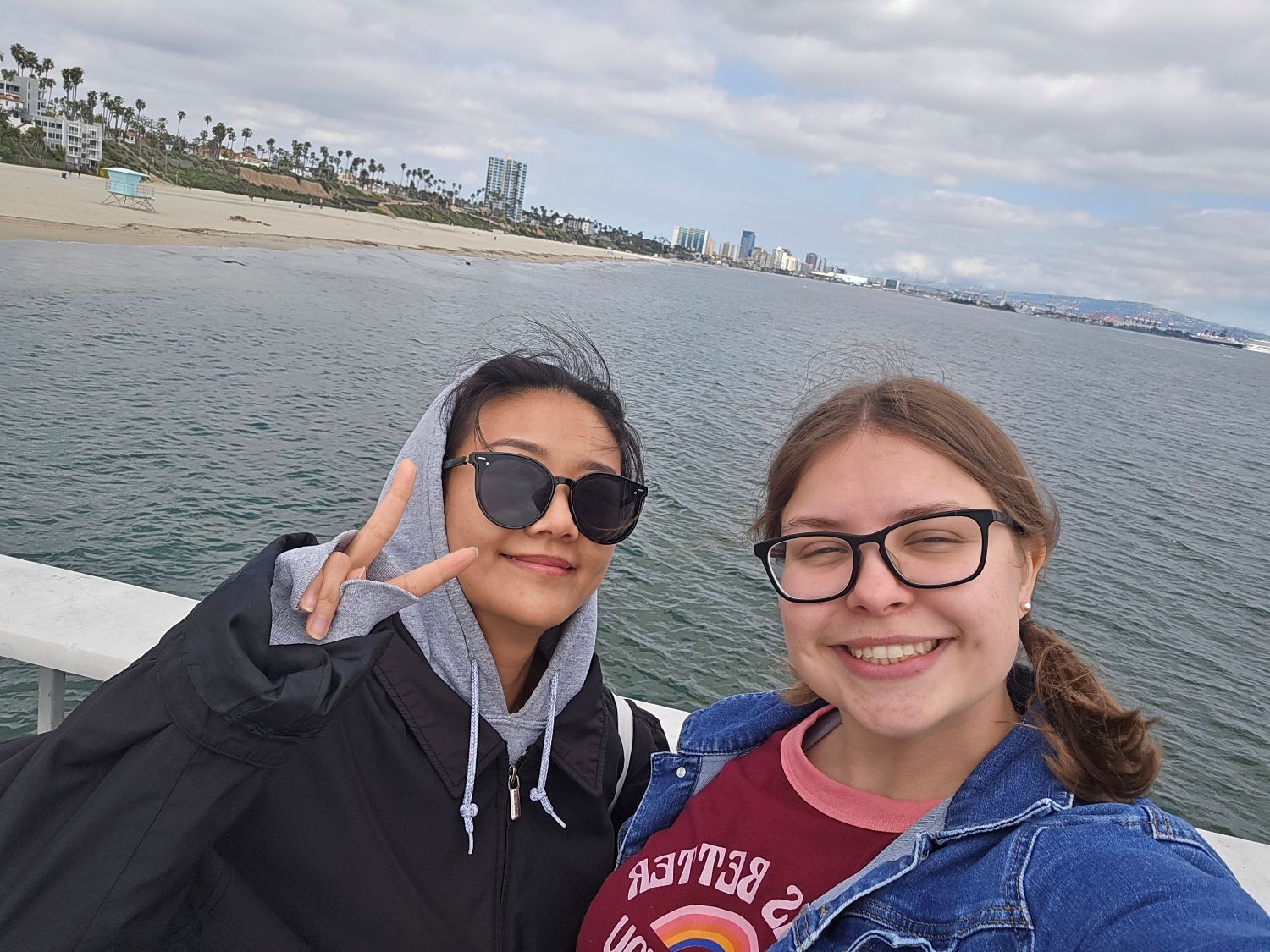
With my friend at the beach on a group outing for Mental Health fieldwork.

I made this fun intervention for pediatrics for a child at fieldwork.
Pediatrics taught me the importance of keeping therapy fun! The number one way to build rapport with a child is to play tag on the playground, build a Lego tower, or race them in an obstacle course. Children need to know that I am an adult that cares about them, who would go the distance to advocate for them, and I found fun to be a way to show that care in a way that is easy to understand. It may seem like a waste of time occasionally, but nobody cares what you know unless they know that you care. A child knows you care when you take the time to speak their language, the language of play and carefree fun. I think this helped me prevent burnout too. When we were having fun together, it was not hard to want to do it forever.

With my friend on the last day of geriatrics fieldwork.
While geriatrics is not always considered a traditional immersion or practice setting, the older adult population is growing, and I feel there will be many opportunities for occupational therapy as we do our best to care for our elders. Although unexpected, I found geriatrics to be my favorite immersion of all. This is truly because of the connections I made with clients and the kindness I experienced at my fieldwork site. I developed a special friendship with one client. My first week at fieldwork, this client took me under their wing and showed me the ins and outs of the facility. They told me that there was something to learn from everyone I interacted with. Every week, I would look forward to seeing this client and learning about their life, their love story, and their career. In short, this was one of the best people I have ever met! About half way through the semester, I learned that this client had passed away. Although this was devastating, it also made me profoundly grateful that I could meet them. If I had geriatrics even a semester later, I would never have met them. This really taught me that we are meant to meet the people we meet, even if it is just for a short time. In OT, there will be clients I only know for a brief period, so I have to do my best for them while I can.

I am posing with some fashionable red glasses and a scarf that my client said were my colors.
Adult rehabilitation is truly the immersion in which I felt I experienced the most growth. I was at a non-traditional placement for this fieldwork experience. It reinforced the lesson I had learned in geriatrics: you can learn something from everyone. It is beyond helpful when you let a client be the expert on something! One client that I developed a strong bond with is a fashion guru and interior designer. They helped me understand what colors look best on me. In return, it became much easier for this client to take my advice, and together we built a lasting rapport!
I am grateful for the experiences I have had in this program. The immersions allowed me to get a feel for what I want to do as an occupational therapist, and they taught me skills that will help me be a better care provider. Many of the skills of a good occupational therapist are also traits of a good person. I hope to continue to develop and embody these skills as I continue in my career!
⋯

A Day in the Life of an Occupational Therapist ⟩
April 14, 2026, by Cindy
At 7:30 AM, the hospital is already in motion. Nurses have just finished their shift transition and move quickly down the hallways—checking blood pressure, administering medications, and preparing patients for the day. Breakfast trays arrive, and the hallways gradually fill with activity—machines beeping, phones ringing, and care teams moving from room to room as patients begin their day.
I begin my day as an occupational therapist in an inpatient hospital setting in the rehabilitation office, where magnets with patient names shape my caseload of the day. I see patients who have just been admitted from a range of specialties—orthopedic surgeries, neurological conditions, and acute medical events. Before seeing anyone, I review medical charts to piece together each patient’s story—who they were before hospitalization and what independence looked like for them. At the same time, I assess their current condition—vital signs, precautions, and risks—to ensure therapy is safe.
There is no fixed schedule—the expectation is to meet visit targets while maintaining strong clinical care. Planning the day feels like solving a constantly changing puzzle. Some patients need pain medication before I arrive, while others are preparing for discharge and require urgent evaluation. Even with a plan, things shift. A patient marked “ready” may not be in their room, and I adjust in real time. Balancing in-person therapy with documentation is essential to stay on track with productivity while ensuring safe and effective care.
Once the nurse confirms the patient is stable and the patient consents, I enter the room to begin therapy. Each session is tailored to the patient’s condition and needs. For instance, a patient recovering from lumbar spinal surgery is often in significant discomfort, even with pain medication, and surrounded by IV lines and drains. Together, we work through the basics—learning how to log roll out of bed, wear a back brace correctly, stand at the sink without bending, and use adaptive tools to get dressed. I remind patients of spinal precautions—no bending, lifting, or twisting (BLT)—guiding each movement carefully to protect the healing spine. What seems simple—brushing teeth or using the restroom—becomes a meaningful step toward independence.
I often notice how meaningful these small moments are for patients. Some have not been able to brush their teeth for days, and even a clean, warm towel to wipe their face can bring a sense of relief. Moments like these are a reminder that the small, everyday activities we often overlook can mean everything when someone is trying to regain their independence.
By 4:30 PM, the day winds down, but what stays with me are these small moments. Occupational therapy is not just about recovery—it’s about helping people return to living their lives, one everyday activity at a time, and ultimately supporting a meaningful and healthy life.
⋯

OT, ST, and PT: What’s the Difference? ⟩
April 13, 2026, by Ciara
What is Occupational Therapy? This is a question commonly thrown my way when I tell people my major. And, believe me, I have no problem answering this question as Occupational Therapy is a rather niche profession that is commonly confused with physical therapy and speech therapy. So, I thought it would be nice to thoroughly tackle this question by explaining how occupational therapy differs from speech therapy and physical therapy.
Occupational Therapy
Occupational Therapy is the holistic based health profession involving Occupational Therapist helping individuals gain independence in occupation regardless of an injury, disability, illness, or obstacle in their life. We refer to everyday activities that add value to one’s life as occupations; they are a key entity in OT’s goal to promote well-being and independence in the categories of physical, mental, emotional, and spiritual health.
What is involved?
Due to Occupational Therapy’s holistic nature and the various populations worked with, a day-in-the-life of an OT is extremely diverse. Some of the tasks OTs are involved in include redesigning the environment to be more inclusive to different conditions, treating children with autism or sensory processing disorders with self-care and social occupations, or helping adults to use adaptive equipment like dressing aids and eating aids.
A great source is to learn more about OTs work is USC Chan’s “Occupational Therapy in Action” page to see how OT’s are involved in various populations (pediatrics, adults, geriatrics, and mental health), while highlighting the Lifestyle Redesign® and Sensory Integration interventions provided at USC Chan:
Who do they treat?
Similar to ST and PT, OTs treat various populations; the graduate program at USC Chan allows students to gain experience with the pediatric, adult, geriatric, and mental health populations through practice immersions. For pediatric populations, it is quite common to find Physical Therapists, Speech-Language Pathologists, and Occupational Therapists working in the same facility. This past summer, I interned at a clinic where there were multiple PTs, SLPs, and OTs within the same facility to help children in a united manner.
What does the pathway look like?
Traditionally, the pathway includes a Bachelor’s degree (~4 years) and an Occupational Therapy Doctorate (~3 years). However, USC Chan offers a 6-year accelerated program where students can get both their BS and OTD degrees in 6 years, shaving off a year of schooling.
❗Personally, “Day in the lives” videos (on TikTok or Youtube) helps me observe and better comprehend what it’s like to follow suit in this career. Plus, finding creators who specialize in the career you’re pursuing can be a nice way to see what’s in store, what obstacles one may face, or any advice from their personal experiences.❗
If you’re interested in the BS-OTD program, watch USC Chan Undergraduate Ambassador Avery’s Day in the Life video:
Or if you’re interested in the OTD program, watch USC Chan Graduate Ambassador Cara’s Day in the Life video as a 1st year E-OTD student:
Speech Therapy:
Speech therapy describes the treatment where a speech language pathologist helps one improve their speaking skills, communication skills, and use and understand other language skills. In fact, speech therapy may also be recommended for those who have a swallowing difficulty or hearing impairment that then impacts their speech.
What is involved?
Speech therapy activities can vary on the population, but usually speech therapy activities include word games, reading certain words out loud, helping using communication devices or sign language, exercises for using a hearing aid, and tongue and mouth exercises (this was an exercise I constantly did when I was younger!). The main areas of focus involve:
- Fluency
- Resonance
- Articulation
- Pronunciation
- Verbal and Written Language
- Swallowing
Who do they treat?
Personally, I took speech therapy for a few years in a school based setting in elementary school to help with the articulation of certain word sounds. However, speech language pathologists can treat both pediatrics and adults.
What does the school pathway look like?
Bachelor’s Degree (~4 years) → [Accredited] Master’s program (2-3 years)
Learn more about the Speech Language Pathology Master’s Program at USC:
Physical Therapy:
The second question I get when I tell people my major is Occupational Therapy is “Is that like Physical Therapy?” Well, Physical Therapy involves treatment from a Physical therapist to help improve strength, mobility, and flexibility as well as relieve pain. It is common to see physical therapy incorporated into one’s life after surgeries or injuries, but a surgery or injury is not necessarily needed for physical therapy to be in one’s life.
What is involved?
Physical Therapy activities include exercises to improve strength, coordination, mobility, and flexibility, as well as more techniques and treatments such as massages and hydrotherapy. Treatment plans are various– some people may need PT for only a few weeks while others may need it for more chronic conditions. Some of the many conditions physical therapist treat include:
- Hip Injuries and pain: (e.g., post hip-replacement surgery)
- Sports injuries (e.g., ACL tears)
- Cerebral Palsy
- Back pain
- Muscular Dystrophy
Who do they treat?
Similarly, Physical Therapists work with various populations ranging from pediatrics to the older adult population.
What does the pathway look like?
Bachelor’s Degree (~4 years) + Doctor of Physical Therapy DPT (3 years)
Learn more about USC’s Division of Biokinesiology and Physical Therapy:
All these professions are essential and hold special places in people’s lives. What set apart Occupational Therapy from Speech Therapy and Physical Therapy for me was its holistic nature. The saying “There is more to a person than meets the eye” stuck with me as I gravitated more and more towards OT, and I’m so excited to continue my journey on the BS-OTD track at USC Chan.
The takeaway from this is not to say how one profession is better than the other, but rather to show how imperative each profession is in our society and how they are not opposing professions but rather supporting professions that work together to help a person feel their best!
⋯
Abilities Expo 2026! ⟩
April 7, 2026, by Trinity
Getting Involved Living in LA Patient Care
On March 29th, I had the opportunity to go to the annual Abilities Expo held in Long Beach, California with two of my good friends from the program. This is a huge event where vendors, advocates, and presenters come together to share products, events, and opportunities.
As an occupational therapy student, this event taught me a lot about what kinds of adaptive equipment are out there. I learned about organizations that focus on adaptive sports and activities. That will be important for me to know so I can make good recommendations to my future clients and patients, both about devices and resources. I also got to interact with many individuals who are disabled and learn about them and their stories, another OT essential.

Some of the coolest equipment I saw included a portable bathtub, an adaptive rock climbing wall, a bowel program support, a standing frame, and adaptive grips for tool use. Most of the equipment was designed or endorsed by a disabled person.
Not only were they showing equipment, but they let us demo some equipment as well. I got to trial an independent lift system and a power chair. In short, it was an occupational therapist’s dream come true!


There was a performance by the Rollettes, a famous dance group known for empowering people with disabilities. Their performance was off the charts! Check their website here for more info!
At USC Chan, we have an assistive tech class specifically designed to help students become familiar with the equipment and devices commonly used by clients. In this class, you learn how to measure someone for a wheelchair, use different modalities for turning electronics on and off, complete a case study and a letter of medical necessity for a client who needs equipment, and learn how to 3-D print. The Abilities Expo was a great addition to that class and a reminder that technology is always changing and becoming better. We need to stay in the know so we can provide the best care and give the best resources.
If you are interested in attending the Expo next year, good news! The dates have been announced: January 14-16, 2027 in Long Beach, California. Check their website for more information and to stay informed!

The next part of the blog is by Cara, another ambassador, who attended the Expo with me!
–
Until recently, I didn’t even know events like the Abilities Expo existed. I’m thankful to Trinity for inviting me, as it was a great opportunity to expand my understanding of how I can better support and advocate for my future patients.
In the Adult Rehab Immersion, I’ve learned a lot about mobile devices and adaptive equipment and how those both can improve patients’ independence, autonomy, and participation in their daily routine. It was cool getting to see many of the wheelchairs, arm supports, and accessible transportation services that I learned in class at the Expo. I, too, drove the power wheelchair and felt like I was in a Fast and Furious movie.
The Expo also featured the latest gadgets and innovations in assistive technology, from portable bathtubs and robotic feeding devices to specialized phone cases for carpal tunnel and smart beds for children with special needs. There were new fashion trends on display too such as fastening a shirt or jacket with magnets.
What stood out to me the most, though, was interacting with the exhibitors, many of whom live with a disability themselves. From cerebral palsy to spina bifida and spinal cord injuries, I was in awe of their resilience. Hearing their lived experiences redefined “disability”, a word that society often views negatively. Individuals with disabilities are not less capable. Rather they’ve just learned a new way of doing things, like anyone else adapting to life’s constant changes.
There was also an ally who wrote a comic book series about superheroes who have a disability, proving that anyone can be heroic. Selfless, empathetic individuals as such reminded me how important it is to provide services that are client-centered to more fully understand the patient’s needs while empowering them to take ownership of their lives.
Overall, the Abilities Expo was enlightening and I feel better equipped as I prepare to join the next generation of healthcare providers. Whether you live with a disability, are a caregiver, or a healthcare provider, I encourage you to attend to help move the needle towards understanding and kindness in society, so we can all thrive.

⋯
Social
Facebook Instagram LinkedIn TikTok YouTube